
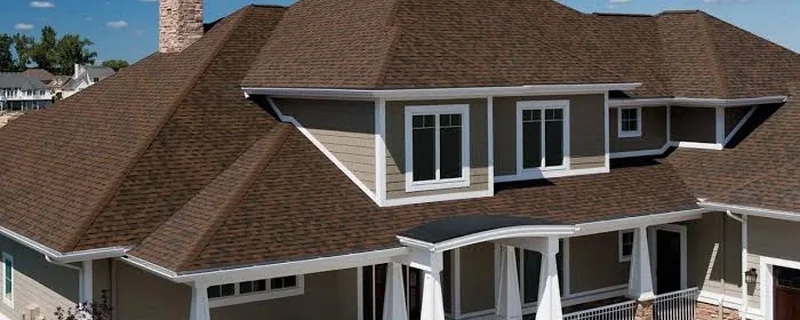
The roof over your family
Homeowners are usually shopping for a roof at the worst possible moment — after a storm, after a leak, after an insurance adjuster has already been out. That is precisely when the decision gets made badly, because three contractors in the driveway all sound confident and only one of them is telling you what is actually on your roof.
What a proper residential installation includes
- Full tear-off down to the decking. A layover hides rot and voids most warranties.
- Decking inspection and repair — soft or delaminated sheathing replaced, not shingled over.
- New underlayment and ice-and-water shield in the valleys and at the eaves.
- New flashing at chimneys, walls, skylights and pipe boots. Reused flashing is the most common leak we get called to fix.
- Corrected ventilation — intake and exhaust balanced, because a hot attic cooks a new roof from underneath.
- Permits pulled and a magnet sweep of the yard before we leave.
Residential roof replacement, start to finish
A residential replacement is a rebuild of the entire water-shedding system, not a fresh layer of shingles. Here is the sequence on a typical John Beal home:
- Free inspection and written scope. We get on the roof, photograph what we find, and put the work in writing line by line before anyone talks price.
- Protection. Tarps over landscaping, plywood at siding and windows, dump trailer placed to spare the driveway.
- Complete tear-off down to bare decking, which is the only way to see what your roof is actually built on.
- Decking repair. Soft, delaminated or rotted sheathing is replaced and shown to you.
- Drip edge at eaves and rakes so water lands in the gutter, not behind it.
- Ice-and-water shield at eaves, valleys and penetrations.
- Synthetic underlayment across the field.
- Sealed starter course at eaves and rakes, where wind damage begins when it is skipped.
- Field shingles to the manufacturer's nailing pattern.
- New flashing and pipe boots at every chimney, wall, dormer and skylight.
- Balanced ventilation — intake at the soffits, exhaust at the ridge.
- Hip and ridge caps in the matching line.
- Cleanup with rolling magnets over the whole property, more than once.
- Final walkthrough with you, and your lifetime workmanship warranty explained before we leave.
Repair or replace: which one does your home need
Repair is right when the failure is isolated — one flashing detail, a few wind-lifted shingles, a cracked pipe boot — and the roof has real life left. Replacement is right when the failure is spread across the system: widespread granule loss, shingles that crack instead of flexing, leaks in several unrelated places, or soft decking underfoot.
The honest test is whether a repair can be expected to hold for years rather than months. We will tell you when repair is the answer, even though it is the smaller sale, and we will tell you when your twenty-year-old roof still has several seasons left in it.
How long a residential roof lasts
- Three-tab asphalt — roughly 15 to 20 years
- Architectural (dimensional) asphalt — roughly 25 to 30 years
- Impact-resistant Class 4 — similar lifespan with far better hail performance
- Designer and luxury asphalt — 30 years and beyond
- Standing-seam metal — 40 to 70 years
Two things shorten every one of those numbers: poor attic ventilation, which bakes shingles from underneath, and hail, which takes years off a roof in a single afternoon. In our markets, most roofs are replaced for storm damage well before they reach the end of their rated life.
Shingles and materials for a home
Architectural asphalt is the default for most homes we roof: laminated layers, a dimensional look, strong wind ratings, sensible cost. Impact-resistant Class 4 shingles deserve a serious look anywhere hail is routine — they are built to survive a standardized steel-ball impact test, and many carriers offer a premium discount for them that can pay back part of the upgrade every year you own the house. Designer lines imitate slate or shake without the structural load. Standing-seam metal costs more up front and outlives everything else. Single-ply membrane belongs on porch roofs and low-slope sections, which cannot shed water fast enough for shingles.
Attic ventilation, ice dams and why they matter
Your roof needs balanced airflow: intake low at the soffits, exhaust high at the ridge. Air enters cool, picks up heat and moisture from the attic and leaves at the top. When a roof has exhaust without intake — a common shortcut — it pulls conditioned air out of your house instead, and performance collapses.
Bad ventilation costs you twice. It cooks shingles from the underside, and most manufacturers condition their material warranty on adequate ventilation, so an unvented roof can invalidate the coverage you paid for. In winter the same defect drives ice dams: heat escaping into the attic melts snow high on the roof, and that meltwater refreezes at the cold eave and backs up under the shingles. We assess intake and exhaust on every residential replacement.
What drives the price of a residential roof
We do not publish a price per square, because a number with no roof attached to it is marketing rather than information. What we can tell you is exactly what moves it:
- Size in squares — one square is 100 square feet of roof surface, not floor area
- Pitch — steep roofs need more safety equipment and slow the work
- Height and access — two- and three-story homes, tight lots, nowhere for a trailer
- Existing layers — every layer is labor and disposal
- Decking condition, which nobody can price honestly until the old roof is off
- Complexity — valleys, dormers, chimneys, skylights, every penetration that needs flashing
- Material selected
- Code-required items in your jurisdiction
- Gutters, fascia, soffit and siding when the storm or the age of the house took those too
The inspection and the written estimate are free, and financing is available when the work is not an insurance claim.
Storm damage, hail and your insurance claim
If a storm caused the damage, your roof may be a claim rather than a purchase. The sequence: we inspect and document the roof with photographs, you file the claim, the adjuster inspects and we meet them on site, the scope is agreed, we do the work, and the held-back depreciation is released.
Hail leaves bruised, granule-stripped impact marks a homeowner rarely sees from the ground. Wind creases shingles and breaks their seal bonds so they lift in the next storm. Both are legitimate claim damage and both are frequently missed by a driveway estimate. We handle claims across all seven markets.
The two warranties on your roof
Every roof carries two. The manufacturer's warranty covers the shingles against defects, and its length often depends on whether the installer is certified. The workmanship warranty covers the installation — the labor, the details, the flashing — and it is worth exactly as much as the company behind it. Ours is a lifetime workmanship warranty, from a family company in business since 1947 and still here in February when the phone rings.
What voids warranties in practice: inadequate ventilation, wrong nail placement or count, reused flashing, pressure washing the shingles, and other trades walking the roof and breaking seal bonds afterward.
Timeline, and how to prepare your home
Most residential replacements are a one- or two-day job on site: tear-off and dry-in on day one, finish work and cleanup on day two, with larger or steeper roofs running longer. Weather moves schedules, and we would rather move a start date than dry a roof in ahead of a storm.
Before the crew arrives: move vehicles clear of the roof line, take pictures and mirrors off walls that share framing with the roof, cover attic storage, put away patio furniture and grills, keep kids and pets inside and away from the work, and expect noise from early morning. Tell us in advance about a satellite dish or solar array so it is handled deliberately.
Permits, code and inspections
Permit requirements are set by your municipality or county, and they vary widely across the 143 cities we serve in four states. We pull the permit where the jurisdiction requires one and build to current code — which can add items your old roof never had, such as ice barrier at the eaves or a ventilation minimum. Those appear as line items rather than surprises, and on an insurance job they are frequently recoverable as code upgrades.
Gutters, siding and everything else the storm hit
Hail and wind rarely stop at the roof. The same storm that bruises shingles dents gutters and downspouts, pocks siding, tears fascia and shreds window screens. Because we install roofing, siding, gutters and windows with our own crews, a single inspection covers the whole exterior and a single scope goes to your adjuster — instead of three contractors, three schedules and three warranties.
Can a roof be replaced in winter?
Yes, with care. Asphalt shingles bond through a heat-activated sealant strip, and in cold weather that bond forms slowly, so cold-weather work calls for hand-sealing in the vulnerable areas and crews who know the material is more brittle in the cold. What we will not do is install in active precipitation or on an iced roof. In practice, winter roofing in the Midwest is a matter of picking the right days — and emergency work gets dried in immediately, in any season.
Choosing a roofer, and avoiding storm chasers
Ask two questions: who installs the roof, and who answers the phone next February. Storm season fills every one of our markets with out-of-state crews, and a workmanship warranty from a company that has left the state is a piece of paper. Warning signs: pressure to sign before the adjuster has been out, an offer to cover or waive your deductible, no local address, no license or insurance certificate, cash up front, and a price that only holds if you decide today.
We are licensed and insured, BBB Accredited, a BBB Torch Award for Ethics recipient, family-owned through three generations since 1947, with more than 50,000 satisfied customers and our own in-house crews in every market we serve.
Services for your home
Roof Replacement
Full tear-off, new underlayment, corrected flashing and proper ventilation — the whole system, not a cover-up.
Roof Repair
Leaks, wind-lifted shingles, failed flashing and storm damage. Repaired right, or honestly told it needs replacing.
Storm & Hail Damage
Free documented inspection, photographed slope by slope, with your claim in mind from the first visit.
Insurance Claims Help
We meet your adjuster at the property and present documented damage so the approved scope matches the roof.
Commercial Roofing
TPO, EPDM, modified bitumen and coatings for property managers, owners and multi-property portfolios.
Gutters & Downspouts
Seamless gutters, guards and downspouts sized to actually move Midwest rain away from your foundation.
24/7 Emergency Repair
A person answers at 2 a.m. We tarp and protect first, then schedule the permanent repair.
Siding & Exteriors
Storm-damaged siding, soffit and fascia repaired or replaced alongside the roof, on one claim and one schedule.
Signs your roof needs attention
- Granules collecting in gutters or at downspout splash blocks
- Shingles curling, cupping or missing after wind
- Dark bruised spots visible in shingle surfaces after hail
- Interior ceiling stains, particularly near chimneys and bathroom vents
- Daylight visible in the attic, or wet insulation
- A roof past twenty years that has never been inspected
Our seven local markets — 143 cities
- St. Louis — 314-429-6000
Hail and straight-line wind off the Missouri and Mississippi river corridors, and a housing stock running from century-old brick two-storys in the city to newer subdivisions in St. Charles County. See St. Louis roofing. - Kansas City, MO — 816-872-9500
Some of the most frequent damaging hail in the country, on everything from postwar ranches to large two-story homes in the Northland and south KC. See Kansas City, MO roofing. - Kansas City, KS — 913-281-6000
The same storm corridor as the Missouri side, served by the same crews and the same 24/7 line. See Kansas City, KS roofing. - Indianapolis — 317-726-6000
Wind events and freeze-thaw cycling, with a large stock of 1950s-90s homes now reaching their second or third roof. See Indianapolis roofing. - Springfield — 417-429-1927
The heart of Ozarks hail country, where a single spring storm can take out whole neighborhoods at once. See Springfield roofing. - Columbia / Jefferson City — (573) 343-8993
Central Missouri storm tracks, mid-century and newer homes, and a steady mix of insurance claims and age-related replacements. See Columbia / Jefferson City roofing. - Lake of the Ozarks — (573) 343-8993
Lake-area homes and second homes with complex rooflines, steep pitches, dormers and long valleys that demand careful flashing. See Lake of the Ozarks roofing. - Metro East & Southern Illinois — 618-549-0800
From the Metro East down through Carbondale, where wind and hail run the same seasons as St. Louis. See Metro East & Southern Illinois roofing.
Frequently asked questions
Tap any question to open it.
How much does a new residential roof cost?
It depends on size in squares, pitch, height and access, how many layers come off, decking condition, the number of flashing details, the material you choose, and code-required items in your jurisdiction. Anyone quoting a price before seeing the roof is guessing. We inspect, then give you a written itemized price you can compare against any other bid, free.
Should I repair or replace my roof?
Repair when the damage is isolated and the roof has real life left. Replace when the problem is spread across the system — widespread granule loss, brittle or curling shingles, leaks in several unrelated areas, or soft decking. We will tell you which situation you are in even when repair is the smaller sale.
How long does a residential roof replacement take?
Most homes take one to two days on site: tear-off and dry-in the first day, finish work and cleanup the second. Larger, steeper or more complex roofs run longer, and weather can move a start date.
How long should a new roof last?
Architectural asphalt generally lasts 25 to 30 years, three-tab 15 to 20, impact-resistant Class 4 similar to architectural with much better hail performance, and standing-seam metal 40 to 70 years. Attic ventilation and hail exposure decide where in that range your roof actually lands.
Do you tear off the old roof or shingle over it?
We always tear off. Roofing over old shingles hides the decking, telegraphs old flaws through the new surface, traps heat, adds weight and complicates every flashing detail.
Do you replace decking and flashing?
Yes to both. Damaged decking is replaced once the old roof is off, and flashing and pipe boots are renewed as part of a standard installation. Reusing old flashing is one of the most common shortcuts in this industry and one of the most common causes of leaks in a new roof.
Will my insurance pay for a new roof?
If a covered storm caused the damage, frequently yes. If the roof is simply worn out, that is normally a home improvement rather than a claim. We inspect and document at no charge, meet your adjuster on site, and tell you honestly which situation you are in.
What does hail damage actually look like?
Bruised, granule-stripped impact marks on the shingle surface, often invisible from the ground, along with dents on gutters, downspouts, vents and flashing. Wind damage shows as creased or lifted shingles whose seal bond has broken.
What is the difference between the material and workmanship warranty?
The manufacturer's warranty covers the shingles against defects. The workmanship warranty covers the installation — the labor and the details. We provide a lifetime workmanship warranty on the roofs we install.
What voids a roof warranty?
Most often inadequate ventilation, incorrect nail placement or count, reused or improperly installed flashing, pressure washing the shingles, and other trades walking the roof and breaking seal bonds afterward.
Why does attic ventilation matter?
A roof needs balanced intake at the soffits and exhaust at the ridge. Without it, heat and moisture build up, shingles age early from underneath, ice dams form in winter, and many manufacturers will not honor the material warranty.
Are impact-resistant shingles worth the upgrade?
In hail country they are worth pricing out. Class 4 shingles withstand a standardized steel-ball impact test and hold up far better in hail, and many insurance carriers offer a premium discount that offsets part of the upgrade every year you own the home.
Can you replace a roof in winter?
Yes, with cold-weather practices — hand-sealing where needed and crews who account for shingles being more brittle in the cold. We will not install in active precipitation or on an iced roof, and emergency work is dried in year round.
Do you pull permits?
We pull the permit wherever the jurisdiction requires one and build to current code. Requirements vary across the 143 cities we serve, and code-required items appear as line items rather than surprises.
How do I prepare my house for the crew?
Move vehicles clear of the roof line, take pictures and mirrors off shared walls, cover attic storage, put away patio furniture and grills, keep kids and pets inside, and expect noise from early morning. Tell us in advance about satellite dishes or solar panels.
Who cleans up the mess?
We do. We tarp landscaping, protect siding and windows, haul all debris, clear the gutters and run rolling magnets over the property more than once for nails. Cleanup is part of the job, not an extra.
Do you offer financing on a residential roof?
Yes, more than one option is available for work that is not going through an insurance claim, and we will walk through what fits alongside the written estimate.
Do you handle gutters and siding at the same time?
Yes. We install roofing, siding, gutters and windows with our own crews, so one inspection covers the whole exterior and one scope goes to your adjuster instead of three contractors on three schedules.
Which cities and markets do you serve?
143 cities across Missouri, Kansas, Illinois and Indiana, from seven local offices: St. Louis, Kansas City, Indianapolis, Springfield, Columbia / Jefferson City, Lake of the Ozarks, and Metro East / Southern Illinois. Emergency service is answered 24 hours a day, every day.
Do you offer emergency roof repair?
Yes, 24 hours a day, seven days a week, with a real person on the phone rather than a queue. When Mother Nature's at her worst, we're at our best.
Are you licensed and insured?
Yes — licensed and insured, BBB Accredited, a BBB Torch Award for Ethics recipient, family-owned and operated through three generations since 1947, with more than 50,000 satisfied customers and in-house crews in every market.
How do I get a free roof inspection?
Call your local office or send the form on this page. We will schedule an inspection, get on the roof, photograph what we find, and give you a written scope and price with no obligation.