
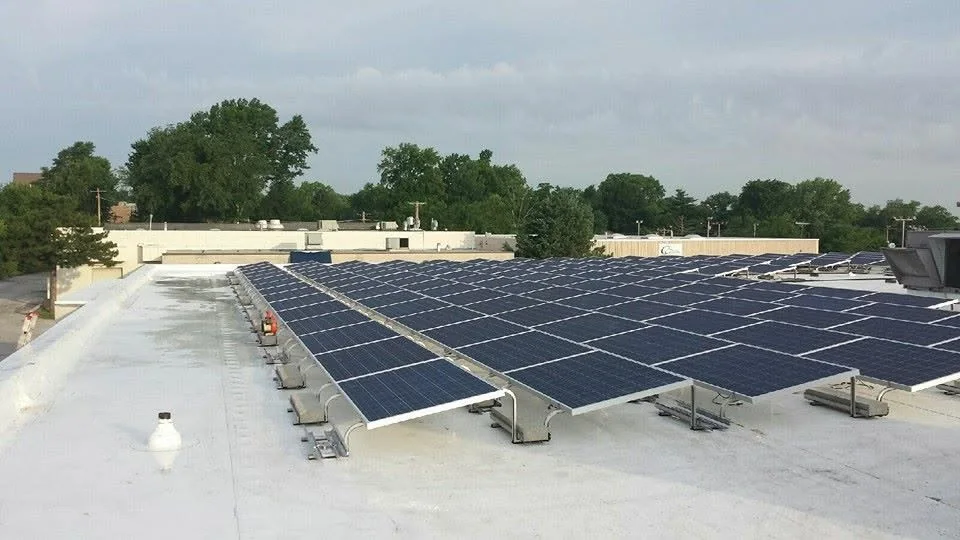
Roofing for buildings that cannot stop operating
A commercial roof is a business decision before it is a construction decision. The question is rarely “is it leaking” — it is whether this roof gets five more years of maintenance or a replacement now, which answer survives an owner's budget review, and what happens to the tenants, the inventory and the operation while the work is going on. We handle low-slope and steep-slope commercial systems, specialty and historic roofing, and the sheet metal that goes with them, with our own crews out of seven local offices and lines answered 24 hours a day.
Low-slope and flat roof systems
TPO
Single-ply thermoplastic with heat-welded seams and a reflective white surface. The workhorse for warehouses, retail and light industrial, and the most common new commercial roof we install. Welded seams are its strength — they are stronger than the membrane itself when welded correctly, which is entirely a workmanship question.
EPDM
Durable rubber membrane, ballasted, mechanically attached or fully adhered. The longest real-world track record in our climate and very forgiving of thermal cycling. Black absorbs heat; white EPDM is available where cooling load matters.
PVC
Single-ply with heat-welded seams and genuine chemical resistance — the right membrane over restaurant kitchen exhaust, food processing and anywhere grease, oils or animal fats hit the roof, which will degrade TPO and EPDM over time.
Modified Bitumen
Multi-ply asphalt systems, torch, cold-adhered or self-adhered. A strong fit for roofs with heavy foot traffic, complex penetrations and mechanical service areas, and easy to repair locally for decades.
Built-Up (BUR)
The traditional multi-ply tar-and-gravel assembly. We still service and repair a great many of them across the region, and they remain a legitimate choice where redundancy and puncture resistance matter most.
Spray Polyurethane Foam
Seamless, self-flashing, and it adds real insulation value while correcting ponding with tapered application. Well suited to roofs with many penetrations. It must be recoated on schedule to protect the foam from UV.
Roof coatings and restoration
A coating is the option most building owners have not been told about, and on the right roof it is the best money on this page: a fluid-applied membrane over a sound existing roof that restores the surface, seals seams and penetrations, and adds years of service life without a tear-off, without a landfill bill, and often as a maintenance expense rather than a capital replacement — a distinction your accountant may care about more than your facilities manager.
Silicone handles ponding water better than anything else and holds up under UV, though it stays slick and attracts dirt. Acrylic is cost-effective and highly reflective, best where drainage is genuinely good. Polyurethane takes foot traffic and impact better than either. Asphalt emulsion remains a fit over aged built-up roofs.
Here is the honest limit: a coating is not a fix for a wet roof. If the insulation below has taken on moisture, a coating seals the water inside and you have bought an expensive delay. That is what a core cut or an infrared scan is for, and it is why we do the assessment before quoting the coating rather than after.
Metal, standing seam and architectural roofing
Standing seam metal is the long-life commercial roof: concealed fasteners, panels that move with thermal cycling, and service lives measured in decades rather than years. We install, repair and re-fasten standing seam, exposed-fastener R-panel and corrugated systems, architectural metal, and metal over existing roofs with a retrofit sub-framing system where a tear-off is not practical.
Most metal roof failures we get called to are not the panels — they are the details: backed-out exposed fasteners with failed neoprene washers, failed sealant at end laps, pipe and curb flashings, ridge and eave terminations, and panels that were fastened in a way that fought thermal movement instead of allowing it. Those are repairable, and a metal roof that is merely leaking at the details does not usually need replacing.
We also fabricate and install the commercial sheet metal that goes with it: coping and parapet caps, gravel stops and edge metal, counterflashing, gutters and oversized downspouts, scuppers and collector heads, curbs and equipment supports.
Specialty and historic roofing
Some roofs are not a membrane decision at all. We work on:
- Churches, steeples and bell towers — steep and often extreme pitch, difficult access, copper and slate details, and congregations that need the building usable on Sunday
- Slate — repair, selective replacement and full re-roofing, including matching salvaged and quarried slate on buildings where the roof is the architecture
- Clay and concrete tile — broken tile replacement, underlayment renewal (the underlayment almost always fails long before the tile does), and full systems
- Copper — standing seam, batten seam, bay roofs, finials, gutters and conductor heads, and historically appropriate detailing
- Historic and landmark buildings, where the work has to satisfy a preservation standard as well as a weather one
- Municipal, school and institutional buildings, with the documentation, bonding and scheduling those projects require
- Steep-slope commercial — apartment communities, condominiums, hotels and mixed-use buildings that are shingle or metal rather than flat
- Skylights, curbs, hatches and smoke vents, which are the most common leak source on an otherwise sound flat roof
- Solar-ready roofing and re-roofing under existing arrays — the roof should always outlive the array mounted to it
If you are not sure whether your building is a specialty job, send photos and we will tell you plainly.
Buildings we work on
Multi-family and apartment communities, condominium associations, office buildings, retail centers and strip malls, warehouses and distribution, light industrial and manufacturing, medical and dental offices, senior living, churches and places of worship, schools and universities, municipal and government facilities, restaurants and hospitality, self-storage, auto dealerships, and mixed-use.
Each of those brings its own constraint. A hospital cannot take odor or noise during patient hours. A restaurant cannot lose a dinner service. A distribution center cannot expose inventory, ever. A school wants the work in the summer window. A condominium association needs a scope its board can approve and its owners can understand. We plan around the operation rather than asking the operation to plan around us.
Repair, restore, or replace — how we decide
Three honest paths, and the money difference between them is large enough that the assessment deserves to be real:
- Repair — the roof is fundamentally sound with isolated failures: open seams, failed pitch pockets, damaged flashing, a punctured area, backed-out fasteners. The right answer far more often than building owners are told.
- Restore — the membrane is weathered and near the end of its surface life but the insulation is dry and the deck is sound. A coating system adds years at a fraction of replacement cost.
- Replace — wet insulation over a meaningful area, a failing or corroded deck, saturated multi-ply assemblies, widespread membrane failure, or a roof that has already been restored once and reached the end.
What makes the decision evidence rather than opinion: core cuts that show the actual assembly and whether the insulation is wet, infrared or moisture scanning that maps saturated areas without cutting the whole roof, drainage and ponding review, deck and structural condition, and the remaining life of the flashings and edge metal. We report what we find with photographs, including when the finding is that you do not need what we sell.
Roof condition assessments and capital planning
Most commercial roofing money is wasted by surprise, not by price. A roof that fails in the middle of a fiscal year becomes an emergency purchase at emergency pricing, with an interior damage bill attached.
A roof condition assessment fixes that. We inspect and photograph each roof, document the assembly, the condition of membrane, flashings, edge metal, penetrations and drainage, estimate remaining service life, and recommend action with a rough order of cost — so a five-year capital plan is built on evidence instead of on which building leaked most recently.
For owners with multiple buildings, that becomes a portfolio document: every roof ranked, so you know which two to do this year and which four can wait, and so you can defend the budget request with photographs rather than adjectives.
Maintenance programs — the cheapest roofing you will buy
Nearly every catastrophic commercial roof failure we are called to started as something that cost a few hundred dollars to fix and was never found. Open seams, failed pitch pockets, a clogged drain, a loose counterflashing, a torn boot around a conduit, storm debris left on the membrane.
A scheduled maintenance program covers two inspections a year plus post-storm checks: drains and scuppers cleared, debris removed, seams and terminations examined, flashings and pitch pockets checked, minor repairs made on the spot, and a documented report with photographs after each visit for your building records and your warranty file.
It also protects the warranty. Most manufacturer warranties require documented maintenance, and a roof that has never been inspected can have its claim challenged on exactly that basis. The program pays for itself the first time it catches something in March instead of finding it in August.
Commercial storm, hail and wind claims
Commercial storm damage is harder to see and easier to underpay than residential. Hail bruises a membrane without opening it — the damage is a fractured mat that will fail in two years rather than a hole that leaks today — and wind damage often shows up as lifted or unseamed membrane edges, displaced ballast, damaged edge metal and coping, and torn flashings rather than anything visible from the parking lot.
What we do on a commercial claim: document the entire roof with dated photographs and a test-square methodology an adjuster can follow, identify collateral damage on soft metals, HVAC units, vents and screens that corroborates the storm, scope the repair to the actual system and manufacturer specification, address code-required upgrades where ordinance-and-law coverage applies, and meet your adjuster at the building. Commercial policies also differ in ways that matter — percentage deductibles, per-building deductibles, actual cash value versus replacement cost, and cosmetic-damage exclusions on metal.
See roof insurance claims and storm damage.
Emergency response on occupied buildings
Water over occupied space, inventory, server rooms or production equipment is a different kind of emergency, and the cost of the roof is rarely the biggest number involved. Our lines are answered 24 hours a day by a person, we dispatch from the nearest local office, and the order of operations is: stop the water, protect what is below it, document the cause before it is covered up, and then schedule the permanent repair.
Documenting before the tarp goes down matters more than most owners realize — once an emergency repair is in place, proving what caused the loss gets considerably harder, and that proof is what an insurance claim turns on.
Working around your operation
The construction is the easy part. Working around a live building is the part that separates commercial contractors:
- Phased work so a section of the building stays operational
- Night, weekend and off-hours scheduling for retail, restaurants and medical
- Odor and fume management, and selecting low-odor or cold-adhered systems near occupied and sensitive spaces
- Tenant and resident notification on multi-family and multi-tenant properties
- Protection of inventory, equipment and interiors, and coordination on anything that has to be moved
- Crane and material staging planned around parking, traffic and deliveries
- HVAC and equipment coordination, including curb work and disconnects with your mechanical contractor
- Safety and site control where the public, staff or students are present
- Daily cleanup and magnet sweeps of lots and drive lanes
Drainage, insulation and code
Two things decide how long a low-slope roof lasts, and neither is the membrane brand.
Drainage. Standing water 48 hours after rain is ponding, and ponding shortens the life of every system, loads the structure, grows vegetation and finds any weakness in a seam. Fixes range from clearing and adding drains and scuppers to tapered insulation that builds positive slope into the assembly.
Insulation. A re-roof is the one opportunity to correct R-value, and energy codes have raised the requirement substantially over the life of most existing buildings. Tapered polyiso can solve slope and insulation in the same layer, and a cover board protects the membrane from hail and foot traffic.
Code and jurisdiction matter too: most jurisdictions limit a building to two roof layers, so a second overlay usually forces a tear-off; wind uplift requirements drive attachment patterns and edge metal detailing; and reflective membranes may be required or incentivized. We pull the permits your jurisdiction requires and build to the assembly the code and the wind-uplift requirement call for.
Warranties on a commercial roof
There are two distinct warranties and owners routinely confuse them. The manufacturer's system warranty covers the materials, and on larger projects can be written as an NDL (no dollar limit) warranty covering both material and labor for a defined term, where the system, the installing contractor and the inspection requirements all qualify. The contractor's workmanship warranty covers the installation.
What owners should know: system warranties generally require documented maintenance and prompt reporting of damage, they exclude damage from other trades — which is why uncoordinated HVAC or satellite work on your roof can quietly void coverage — and they typically require manufacturer approval before anyone penetrates or modifies the roof. Keep the warranty document, the maintenance reports and the photographs together in one file, and require any contractor working on your roof to notify you before they touch it.
Managing a portfolio?
We work with property managers, asset managers, condominium boards and multi-property owners across all seven markets under one point of contact, with consistent documentation, condition reports and capital planning across the portfolio rather than a different contractor and a different report format at every building.
See our property management page, or call the market office nearest the property.
Who you are hiring
A 20-year roof system is a promise about a company's next 20 years. John Beal Roofing has been in business since 1947, family-owned through three generations, with more than 50,000 satisfied customers, in-house crews in seven local markets rather than subcontracted labor, a lifetime workmanship warranty on installations, 24/7 emergency service answered by a person, and a permanent local address at 12181 Prichard Farm Rd, Maryland Heights, MO 63043.
Licensed and insured (License # 104.011957/105.007037), BBB Accredited, and a BBB Torch Award for Ethics recipient — an award for ethics, not for advertising. Certificates of insurance, references and documentation for bid packages are available on request.
Our seven local markets — 143 cities
We roof commercial and specialty buildings in 143 cities from seven local offices. Each market has its own crews and its own number — call the office nearest the building.
- St. Louis — (314) 429-6000
Our home market since 1947 and the largest commercial crew base, covering the metro and surrounding counties. - Kansas City — (816) 872-9500
Commercial and multi-family work on both sides of the state line, with heavy hail-claim volume. - Indianapolis — (317) 726-6000
Warehouse, distribution, retail and multi-family across the metro and surrounding counties. - Springfield — (417) 429-1927
Commercial and institutional work in Ozarks-edge hail country, where storm claims drive much of the volume. - Columbia / Jefferson City — (573) 343-8993
Mid-Missouri commercial, institutional and state-facility work with local crews and a local number. - Lake of the Ozarks — (573) 343-8993
Hospitality, condominium associations, retail and rental property throughout the lake area. - Metro East & Southern Illinois — (618) 549-0800
Commercial and industrial work along the Mississippi storm corridor, with frequent hail and wind claims.
Commercial roofing questions, answered
Tap any question to open it.
What types of commercial roofing do you install?
TPO, EPDM, PVC, modified bitumen, built-up (BUR), spray polyurethane foam and fluid-applied coating systems on low-slope roofs; standing seam, exposed-fastener and architectural metal; and steep-slope commercial shingle and metal on apartments, condominiums, hotels and mixed-use. We also do specialty and historic work — church and steeple, slate, clay and concrete tile, copper — plus commercial sheet metal.
Do you do specialty and historic roofing?
Yes. Churches, steeples and bell towers, slate repair and re-roofing, clay and concrete tile, copper standing seam and batten seam, historic and landmark buildings with preservation requirements, and municipal and institutional projects with the documentation and scheduling those require.
What is the best flat roof system?
It depends on the building rather than the brand. TPO is the common choice for warehouses, retail and light industrial. EPDM has the longest real-world record in our climate. PVC is the right answer over restaurant kitchen exhaust and anywhere grease or chemicals reach the roof. Modified bitumen suits heavy foot traffic and complex penetrations. Spray foam adds insulation and corrects ponding.
Can a coating save my roof instead of replacing it?
Sometimes, and it is worth asking. If the membrane is fundamentally sound and the insulation is dry, a coating adds years of service life at a fraction of replacement cost — and it is often treated as maintenance rather than capital expense. If there is trapped moisture in the insulation, a coating seals the problem inside. Core cuts or an infrared scan decide it.
How long does a commercial roof last?
Broadly: TPO and PVC 20 to 30 years, EPDM 20 to 30, modified bitumen 15 to 25, built-up 20 to 30, spray foam 20 or more with recoating on schedule, standing seam metal 40 or more, and a coating system typically adds 10 to 20 years to a sound roof. Drainage, maintenance and installation quality move those numbers more than the material does.
How much does a commercial roof cost?
Too many variables for a web page number: system and thickness, total square footage, tear-off versus overlay versus restoration, insulation and cover board, deck condition, drainage corrections, the number of penetrations and curbs, edge metal and coping, access and staging, phasing around your operation, and code-required upgrades. The assessment and written scope are free.
Do you offer commercial roof maintenance contracts?
Yes, across all seven markets — two inspections a year plus post-storm checks, drains and scuppers cleared, seams, flashings and pitch pockets examined, minor repairs made on the spot, and a documented photographic report after each visit for your building records and your warranty file.
Do you provide roof condition reports for budgeting?
Yes. We inspect and photograph each roof, document the assembly, report condition, remaining service life and recommended action with a rough order of cost, so capital planning is based on evidence rather than on which building leaked most recently. For multi-building owners we rank the whole portfolio.
Can you work around our business hours?
Yes — night, weekend and off-hours scheduling, phased work so part of the building stays operational, low-odor or cold-adhered systems near occupied and sensitive spaces, tenant notification, protection of inventory and equipment, and staging planned around parking and deliveries.
What is ponding water and does it matter?
Standing water still on the roof 48 hours after rain. It shortens the life of every system, adds structural load, grows vegetation and finds any weakness in a seam — and it voids some manufacturer warranties. Fixes range from clearing and adding drains and scuppers to tapered insulation that builds positive slope into the assembly.
How do I know if my roof insulation is wet?
You generally cannot from the surface, which is the problem. Core cuts show the actual assembly and whether the insulation is saturated; infrared or moisture scanning maps wet areas across the roof without cutting all of it. This is the single most important thing to establish before anyone quotes you a coating.
Can you roof over an existing commercial roof?
Sometimes, but most jurisdictions limit a building to two roof layers, so if there are already two the code forces a tear-off. An overlay also has to be over a dry assembly and a sound deck. Recovering a wet roof buys a short delay and a bigger bill.
Does insurance cover commercial hail damage?
Frequently, and commercial hail damage is widely underpaid because it is hard to see — hail can fracture a membrane's mat without opening it, so the roof fails in two years rather than leaking today. We document the roof with dated photographs and a test-square methodology, identify corroborating soft-metal damage, and meet your adjuster at the building.
How are commercial insurance policies different?
In ways that cost real money: percentage deductibles rather than flat dollar amounts, per-building deductibles across a portfolio, actual cash value versus replacement cost, cosmetic-damage exclusions on metal roofs, and ordinance-and-law coverage that determines whether code upgrades get paid. Read those before a storm, not after.
Do you respond to commercial roof emergencies?
Yes, 24 hours a day, answered by a person, dispatched from the nearest local office. Water over occupied space, inventory, server rooms or production equipment is the priority. We stop the water, protect what is below, and document the cause before it is covered up — that documentation is what a claim turns on.
What is an NDL warranty?
A no dollar limit manufacturer warranty covering both material and labor for a defined term, where the system, the installing contractor and the inspection requirements all qualify. It is separate from the contractor's workmanship warranty, and it generally requires documented maintenance and prompt reporting of damage to stay in force.
What voids a commercial roof warranty?
Most often: no documented maintenance, unreported damage, ponding water, and work by other trades — uncoordinated HVAC, satellite, solar or sign installation that penetrates the roof. Most warranties require manufacturer approval before anyone modifies or penetrates the membrane. Require every contractor to notify you before they go up.
Do you repair metal and standing seam roofs?
Yes, and most metal roofs we are called to do not need replacing. The failures are usually details rather than panels — backed-out fasteners with failed washers, failed sealant at end laps, pipe and curb flashings, ridge and eave terminations, and panels fastened in a way that fought thermal movement. Those are repairable.
Do you work on churches and steeples?
Yes. Steep and extreme pitch, difficult access, copper and slate detailing, steeples and bell towers, and scheduling that keeps the building usable for services. Historic and landmark buildings with preservation requirements are part of this work as well.
Do you work on apartment and condominium properties?
Yes — multi-family communities, condominium associations and mixed-use buildings, flat or steep-slope, with resident notification, phased scheduling, portfolio-wide condition reports, and scopes written so a board can approve them and owners can understand them.
Can you roof around or under an existing solar array?
Yes, and it is a conversation worth having early: the roof should always outlive the array mounted to it. We handle re-roofing under existing arrays in coordination with your solar provider, and solar-ready roofing where an array is planned.
Do you replace skylights, curbs and hatches?
Yes. Skylights, equipment curbs, roof hatches and smoke vents are the most common leak source on an otherwise sound flat roof, and they are frequently repairable or replaceable without touching the rest of the membrane.
Are you licensed, bonded and insured?
Licensed and insured (License # 104.011957/105.007037), BBB Accredited, and a BBB Torch Award for Ethics recipient. Certificates of insurance, references and documentation for bid packages are available on request — ask and we will send them.
Which cities do you serve for commercial roofing?
143 cities across Missouri, Kansas, Illinois and Indiana from seven local offices: St. Louis, Kansas City, Indianapolis, Springfield, Columbia / Jefferson City, Lake of the Ozarks, and Metro East and Southern Illinois. Call the office nearest the building.
Where we work
The Best Value Guarantee
Bring us a qualifying written estimate from a qualifying contractor and we will compare it against ours. If we can match or improve the value, you agree to let us do the work. If we decide not to match or improve it, we refund your deposit and pay you an additional $200 — in writing. When Mother Nature's at her worst, we're at our best.