
Home › Commercial Roofing › PVC roofing — the membrane for grease, chemicals and fire exposure
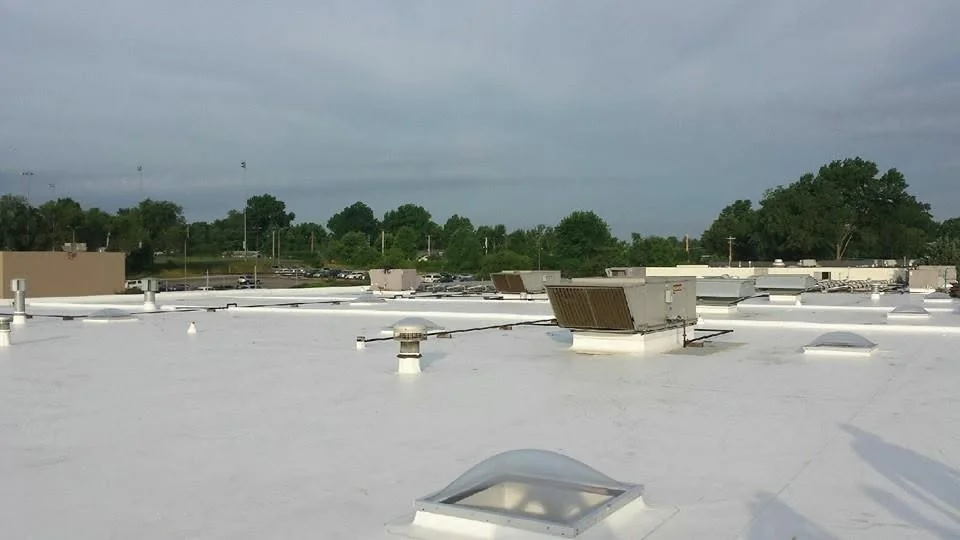
PVC roofing — the membrane for grease, chemicals and fire exposure
PVC is the answer to a specific and expensive problem. Restaurant kitchen exhaust throws airborne grease and animal fat onto the roof around it, and those contaminants chemically attack both TPO and EPDM — which is why the roof around a kitchen hood fails years before the rest of the building does, over and over, until somebody installs the right membrane. PVC resists it. If you own a restaurant, a food plant, a hotel with a commercial kitchen or an industrial building with chemical discharge, this is the page that matters.
Why the roof around your kitchen hood keeps failing
This is the most useful thing on this page, so it gets stated plainly. Grease-laden vapor from a commercial kitchen exhaust fan does not simply sit on the roof — animal fats and petroleum-based contaminants chemically break down TPO and, especially, EPDM. The membrane softens, swells, loses adhesion at seams and flashings, and fails in a defined zone around the exhaust discharge, typically long before the rest of the roof shows its age.
Owners usually experience this as a mystery: repeated leaks in the same area, repaired repeatedly, that keep coming back. It is not bad repair work. It is the wrong membrane in a contaminated zone.
Two legitimate fixes. Install PVC across the whole roof when the building is a restaurant or food facility. Or install a PVC section in the contaminated zone around the exhaust, welded to a compatible membrane elsewhere — a targeted, cost-effective solution on an otherwise sound roof. Grease containment at the hood itself belongs in the conversation too, since it protects whatever membrane is underneath.
What PVC is and where it belongs
PVC is a thermoplastic single-ply membrane, typically 50, 60 or 80 mil, with hot-air-welded seams — the same welding principle as TPO, so seams become a continuous sheet rather than a glued lap. What separates it is chemistry: plasticizers keep it flexible, and its formulation resists what destroys other membranes.
It belongs on:
- Restaurants and any building with commercial kitchen exhaust — the classic case
- Food processing and packing plants
- Hotels, hospitals, schools and stadiums with commercial kitchens
- Industrial buildings with chemical, solvent or oil discharge
- Auto and truck facilities, where petroleum exposure is routine
- Buildings where fire resistance is a priority — PVC is inherently flame-resistant and self-extinguishing
- Roofs with chronic ponding, which PVC tolerates better than most membranes
- Green roofs and vegetated assemblies, where root resistance matters
PVC compared with TPO and EPDM
All three are single-ply, and PVC and TPO are both hot-air welded, so the practical differences come down to chemistry, cost and track record.
- Chemical and grease resistance — PVC clearly first, TPO moderate, EPDM poor. Decisive near kitchens and industrial discharge.
- Fire resistance — PVC is inherently flame-resistant and self-extinguishing. A real consideration near exhaust.
- Ponding tolerance — PVC handles standing water better than TPO, though ponding should still be corrected.
- Flexibility with age — PVC relies on plasticizers, and very old formulations could grow brittle as plasticizers migrated out. Modern formulations are far better, but it is the honest historical knock.
- Cost — PVC is typically the most expensive of the three. On the right building it is cheaper than replacing a TPO roof twice.
If grease, chemicals or fire exposure are not part of your building's reality, TPO or EPDM is usually the better value and we will say so.
How PVC goes on
Mechanically attached, fully adhered or induction welded, over insulation — usually polyiso, often tapered to build positive slope — and a cover board that protects against hail and rooftop foot traffic. Seams are hot-air welded into a continuous sheet, then probe-tested.
Two details worth insisting on. First, compatibility: PVC must be separated from asphalt-based materials and some insulations, because direct contact causes plasticizer migration and premature failure. A separator sheet handles it, and skipping it is a real failure mode we have been called to repair. Second, perimeter and corner attachment: uplift zones require tighter fastening than the field, and that is where wind failures start on every low-slope roof.
Kitchen-specific detailing matters as well: proper flashing at exhaust curbs, grease containment at the hood, and walk pads along service routes so the technicians who visit the fan monthly are not grinding debris into your membrane.
Repairs, restoration and replacement
Repair — PVC is a thermoplastic, so new membrane welds into the original sheet and the repair becomes part of the roof. Seams, pipe boots, punctures, pitch pockets, curb and skylight flashings are routine.
Restore — a weathered but sound PVC roof with dry insulation can take a compatible fluid-applied coating, adding years at a fraction of replacement cost and often as maintenance rather than capital expense.
Replace — when moisture scanning or core cuts show wet insulation across a meaningful area, when an older membrane has grown brittle and cracks at seams and terminations, or when the deck is deteriorating.
Common PVC failures: brittleness on very old membranes, punctures from foot traffic on service routes, failed penetration flashings, and failures caused by contact with incompatible asphalt materials where a separator sheet was omitted.
Maintenance around kitchens and industrial exhaust
A PVC roof on a restaurant needs a maintenance program more than an office roof does, because the building itself is actively depositing contaminants and sending technicians up to service the fan.
Two inspections a year plus post-storm checks, and on food-service buildings we look specifically at grease accumulation around exhaust discharge, containment devices at the hood, walk pads along service routes, punctures and abrasion near equipment, exhaust curb flashings, drains and scuppers clogged with grease-bound debris, and seam integrity in the contaminated zone. Minor repairs are made on the spot and a photographic report is filed after each visit.
That file protects the warranty as well — manufacturer coverage generally requires documented maintenance, and damage from other trades servicing rooftop equipment is a common way coverage quietly lapses.
Storm damage and insurance on PVC roofs
Hail can fracture a PVC membrane's reinforcement beneath a surface that still looks sound, and can crush insulation below an intact-looking sheet — damage that reads as nothing today and as a failing roof in two years. A cover board is the best defense and is frequently the item cut from a low bid.
Wind damage concentrates at perimeters and corners: lifted membrane, failed termination bars, displaced coping and edge metal. On restaurants specifically, high wind also damages exhaust equipment and curbs, and that damage belongs in the claim.
Commercial policies carry percentage or per-building deductibles and sometimes cosmetic exclusions — worth reading before a storm rather than after. See storm damage and roof insurance claims.
Restaurants and food service across our markets
We roof restaurants, hotels with commercial kitchens, food processing and packing plants, grocery and convenience retail, schools, hospitals and senior living with institutional kitchens, breweries and distilleries, and industrial buildings with chemical or oil discharge.
Restaurant and hospitality density is highest around St. Louis, Kansas City and Indianapolis; resort and hospitality kitchens lead at the Lake of the Ozarks; institutional and campus kitchens are a large share in Columbia and Jefferson City; and food processing and industrial discharge buildings run through Metro East and Southern Illinois and Springfield. Every one of those buildings has the same constraint: the kitchen cannot close for a roof.
Our seven local markets — 143 cities
We install and service PVC membrane roofs from seven local offices covering 143 cities in Missouri, Kansas, Illinois and Indiana. Each market runs its own crews and its own number — call the office nearest the building.
Questions, answered
Tap any question to open it.
What is PVC roofing?
PVC is polyvinyl chloride, a single-ply thermoplastic roofing membrane with hot-air-welded seams, typically 50, 60 or 80 mil. Its distinguishing property is genuine resistance to grease, animal fats, oils and chemicals, plus inherent fire resistance — which makes it the correct membrane over commercial kitchen exhaust and industrial discharge.
Why does the roof around my restaurant's kitchen exhaust keep leaking?
Because grease-laden vapor chemically degrades TPO and especially EPDM. The membrane softens, swells and loses adhesion in a zone around the exhaust, so the same area leaks again after every repair. It is not bad repair work — it is the wrong membrane in a contaminated area. PVC resists it.
Is PVC better than TPO?
For grease, chemical or fire exposure, clearly yes. Otherwise TPO is usually the better value, and we will tell you so. Both are hot-air welded single-ply membranes; PVC's advantages are chemical resistance, flame resistance and better ponding tolerance, at a higher cost.
Can I install PVC only around the kitchen exhaust?
Yes, and it is a common, cost-effective fix on an otherwise sound roof: a PVC section in the contaminated zone, welded to a compatible membrane elsewhere. Grease containment at the hood should be part of the solution too, since it protects whatever membrane is underneath.
How long does a PVC roof last?
Generally 20 to 30 years when well installed over a sound, dry assembly, and modern formulations hold flexibility far better than early ones did. Weld quality, cover board, drainage and maintenance drive the number more than brand does.
Is PVC fire resistant?
PVC is inherently flame-resistant and self-extinguishing, which is a genuine consideration on a building with kitchen exhaust or industrial discharge on the roof. It is one reason food-service buildings specify it.
Does PVC handle standing water?
It tolerates ponding better than TPO, but ponding should still be corrected — standing water 48 hours after rain shortens the life of every system, adds structural load, grows vegetation and can void manufacturer warranties. Tapered insulation or added drains solve the cause.
What is plasticizer migration?
PVC stays flexible because of plasticizers. In very old formulations those could migrate out over time, leaving the membrane brittle. Modern PVC is dramatically better, but direct contact with asphalt-based materials still causes it — which is why a separator sheet between PVC and any asphalt product is required, and why omitting it causes premature failure.
Can PVC be repaired?
Yes. Because PVC is a thermoplastic, new membrane heat-welds into the original sheet, so a repair becomes part of the roof rather than a patch on top of it. Seams, pipe boots, punctures, pitch pockets and curb flashings are all routine.
Can you coat a PVC roof instead of replacing it?
Often, with a compatible fluid-applied system, provided the insulation underneath is dry. It adds years at a fraction of replacement cost and is frequently treated as maintenance rather than capital expense. Core cuts or an infrared scan confirm the assembly is dry first.
How much does a PVC roof cost?
PVC typically costs more per square foot than TPO or EPDM, and on a restaurant or food plant it is still cheaper than replacing the wrong membrane twice. Price depends on square footage, thickness, attachment, tear-off versus overlay, insulation and cover board, deck condition, drainage, penetrations and phasing. The assessment is free.
Can you work around our restaurant hours?
Yes — night, early-morning and off-hours scheduling, phased work so the kitchen keeps operating, low-odor system selection near occupied spaces, and staging planned around deliveries and parking. Losing dinner service usually costs more than the roof section being replaced that day.
Do you offer maintenance programs for restaurant roofs?
Yes, and food-service buildings need them most: grease accumulation around exhaust checked, containment devices reviewed, walk pads inspected, punctures near equipment found, curb flashings examined, grease-clogged drains cleared, minor repairs on the spot, and a photographic report after each visit.
Where do you install PVC roofing?
143 cities across Missouri, Kansas, Illinois and Indiana from seven local offices: St. Louis, Kansas City, Indianapolis, Springfield, Columbia and Jefferson City, the Lake of the Ozarks, and Metro East and Southern Illinois.
Other commercial systems we install
Back to commercial & specialty roofing, or see property management, storm damage and roof insurance claims.
Where we work
The Best Value Guarantee
Bring us a qualifying written estimate from a qualifying contractor and we will compare it against ours. If we can match or improve the value, you agree to let us do the work. If we decide not to match or improve it, we refund your deposit and pay you an additional $200 — in writing.