
Home › Commercial Roofing › Property Management
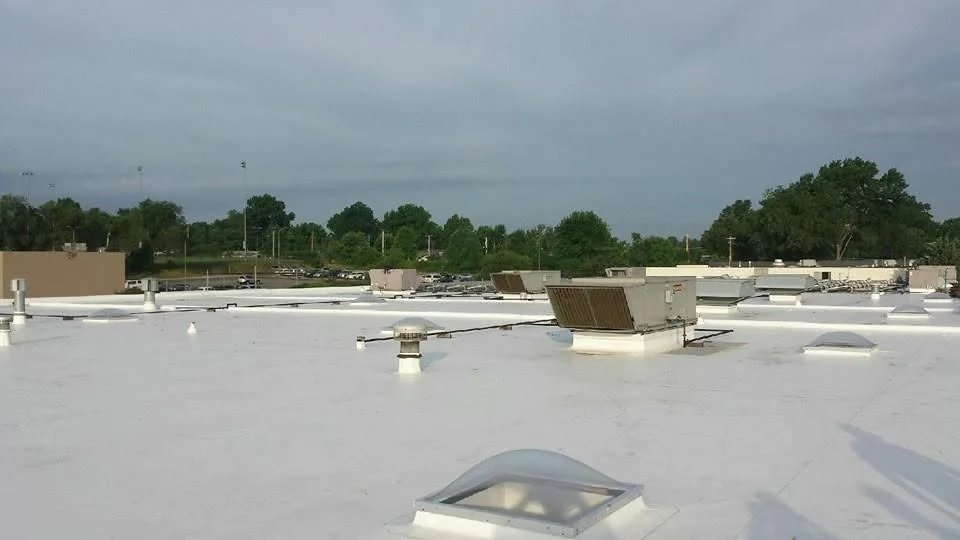
Commercial roofing for property managers and portfolio owners
Property management is a different job than roofing, and the roofing contractor who understands that is worth more than the one with the lowest number. You are managing budgets set a year in advance, owners who want capital forecasts rather than surprises, tenants whose leases say their space stays dry, and a portfolio where the roof you are not thinking about is the one about to leak. What you need from a roofer is documentation, predictability, and someone who answers the phone at 2 a.m. — in that order.
One point of contact for every building you manage
The most common complaint we hear from managers who come to us is not about workmanship. It is about administration: five buildings, four contractors, three invoicing formats, nobody who knows the history of any roof, and a leak call that starts with explaining which building you are talking about.
What consolidating looks like in practice:
- One phone number and one point of contact who knows your portfolio, not a call center.
- A roof file per building — system type, age, assembly, warranty status, every inspection, every repair, every photo. So the history does not live in your inbox.
- Consistent documentation — the same report format across every property, which makes comparing buildings possible and makes owner reporting a copy-and-paste rather than a project.
- Consolidated invoicing and reporting aligned to how you bill owners, with work orders referencing your property codes.
- Coverage across all seven of our markets, so a portfolio spread from St. Louis to Kansas City to Indianapolis does not need three vendors.
We are also large enough to handle a whole portfolio and family-owned enough that you are not a ticket number. Those two things usually do not come together, and they are the reason most of our management relationships have outlasted the buildings' original roofs.
Roof condition assessments and remaining-life reporting
You cannot budget for what you have not measured, and most portfolios we inherit have no reliable record of what is actually on the roofs. An assessment fixes that, building by building.
What we document per roof: system type and assembly confirmed by core cut (not guessed from a walk-by), membrane or covering condition, insulation condition and whether it is wet — verified by core cuts and, where it matters, infrared or moisture scanning — drainage performance and ponding, flashing and penetration condition, edge metal and parapet condition, the deck's condition where visible, rooftop equipment and any damage caused by other trades, code and safety observations, and dated photographs throughout.
What you get back: a remaining-life estimate with the reasoning behind it, a defect list separated into safety, active-leak, near-term and monitor categories, budget ranges for each recommended action, and a plain statement of whether the roof is a repair, restoration or replacement candidate. Including when the answer is that it needs nothing yet. A report that recommends replacement on every roof is a sales document, not an assessment.
Capital planning across a portfolio
The point of assessing everything at once is that you can then sequence it. A portfolio plan turns a pile of roofs into a defensible multi-year schedule an owner or board can approve.
How we build it: rank roofs by remaining life and consequence of failure — a five-year roof over a data room outranks a three-year roof over a warehouse of pallets; separate what must be spent from what can be deferred, with the risk of deferring stated honestly; identify the restoration candidates, which are the highest-leverage line items in any plan because a coating at the right moment defers a replacement by years for a fraction of the cost and often lands as an operating rather than capital expense; spread replacements across fiscal years so no single year carries an impossible number; and flag roofs where waiting is actively expensive because wet insulation is spreading.
We update the plan annually off the maintenance inspections, so it stays a live document rather than a study that ages on a shared drive. Owners tend to approve capital when the reasoning and the photographs are in front of them.
Preventive maintenance programs
This is the highest-return line item in portfolio roofing, and it is the one most often cut. Deferred maintenance does not save money; it converts a repair budget into a capital budget, usually on the least convenient schedule.
A program covers two scheduled inspections a year — spring and fall — plus post-storm checks, with each visit clearing drains, scuppers and gutters, removing debris, probing seams and laps, examining pipe boots, pitch pockets and curb flashings, checking terminations, edge metal and coping, documenting damage or penetrations created by other trades, making minor repairs on the spot, and filing a dated photographic report afterward.
Two things that report does beyond telling you the roof's condition. It protects your warranties, because most manufacturer system warranties require documented maintenance and prompt reporting of damage, and a roof with no inspection history hands a manufacturer or carrier an easy denial. And it protects your claims, because pre-storm documentation of good condition is the strongest rebuttal to a carrier arguing that damage was pre-existing wear.
24/7 emergency response on occupied buildings
Leaks do not respect business hours, and on an occupied building the roof is rarely the most expensive thing failing — the tenant's inventory, equipment, records or ceiling is. Our standard is to stop the water first and diagnose second.
Emergency response means someone answers the phone, at any hour, in every market we serve. On arrival we stop active water intrusion with temporary measures, protect the tenant's property and coordinate with their people, document the source and the resulting damage photographically for the claim file, report to you the same day with what happened and what it will take to fix permanently, and schedule the permanent repair around the building's operation.
Tenant relations are part of this work whether the roofer acknowledges it or not. A crew that shows up unannounced, blocks the loading dock and leaves debris in the parking lot creates problems that land on your desk, not ours. Ours check in, stage where they are told, protect entries and landscaping, and clean up daily.
Storm damage and insurance claims across multiple buildings
A hail or wind event that crosses a metro hits several of your buildings at once, and the claim work becomes the whole job for a while. This is where documentation discipline pays for itself.
We inspect every affected property on a consistent methodology, document hail with test squares showing impact density per 100 square feet in a form an adjuster can follow, photograph corroborating damage on soft metals, vents, equipment and fencing, take core cuts where crushed or wet insulation is the question, prepare a per-building damage report and scope, meet your adjuster at each property, and address code-required upgrades and supplements where the repair triggers current code.
Two commercial-policy realities worth knowing before a storm rather than after: many policies carry percentage or per-building deductibles rather than flat ones, which changes the math on whether a claim is worth filing; and some carry cosmetic damage exclusions or settle on actual cash value once a roof passes a certain age. We will tell you plainly when a building's damage is unlikely to clear its deductible. See storm damage and roof insurance claims.
Working around tenants, operations and leases
A roof replacement on an occupied building is a logistics project with roofing attached. What we plan before a crew mobilizes: phasing so the building is dried in every night and no section is left open; staging, crane and dumpster placement worked out against parking, docks, drive aisles and fire lanes; tenant notification with real dates and a real schedule, provided far enough ahead that you can send it out; noise-sensitive scheduling — demolition timed around medical offices, class hours, dinner service, call centers; odor control near occupied space, with self-adhered or cold-applied systems specified instead of hot asphalt where that matters; protection of entries, landscaping, vehicles and rooftop equipment; and coordination with your HVAC, solar, electrical and sign vendors so nobody penetrates a new membrane in week two.
On schools we work summers and breaks. On medical and food service we work nights and early mornings. On warehouses we work around dock schedules. On multi-family we work building by building so residents always have a dry unit.
Multi-family, HOA and condominium boards
Board-governed property has its own requirements, and they are mostly about process. What we bring to it: attendance at board or annual meetings to present findings and answer owner questions directly; written scopes plain enough that a volunteer board can evaluate competing bids on the same terms; documentation suitable for a reserve study, with remaining-life estimates and budget ranges the reserve analyst can use; phasing across buildings and fiscal years so a large association is not assessed all at once; and clear communication to residents about schedule, noise, parking and access.
We also handle the situation boards land in most often: a roof that was installed cheaply, a warranty nobody can locate, and a leak in a unit whose owner is now on the board. That starts with establishing what is actually on the roofs, because you cannot evaluate options without that.
Every system on your portfolio, under one contractor
Portfolios are rarely uniform — a single management company will have low-slope membrane on the retail, asphalt shingles on the townhomes, metal on the industrial building and a fifty-year-old built-up roof downtown. We work on all of it, which is the practical reason consolidating vendors is possible in the first place.
Plus residential and multi-family systems: residential roofing, roof replacement, roof repair, gutters and siding. And when the honest recommendation is a coating or a repair rather than the replacement a competitor quoted, we say so — the point of a portfolio relationship is the tenth year of it, not the first invoice.
Buildings and portfolios we manage roofing for
Retail centers and strip malls, office buildings and office parks, apartment communities and multi-family portfolios, condominium and HOA properties, medical office buildings, industrial and warehouse portfolios, self-storage, hospitality and restaurants, schools and municipal facilities, churches, and mixed-use developments.
What varies by market is storm exposure and building stock. Large retail, office and industrial portfolios concentrate around St. Louis, Kansas City and Indianapolis; hail claim volume drives portfolio work in Springfield and across Metro East and Southern Illinois; institutional, state and university-adjacent property leads in Columbia and Jefferson City; and condominium, resort and hospitality management dominates at the Lake of the Ozarks.
Our nine local markets — 203 cities
We serve property managers and portfolio owners from nine local offices covering 203 cities in Missouri, Kansas, Illinois and Indiana — so a portfolio spread across metros still runs through one relationship. Each market has its own crews and its own number.
Questions, answered
Tap any question to open it.
Do you work with property management companies?
Yes — property managers, asset managers, HOA and condominium boards, and portfolio owners are a core part of our commercial business. You get one point of contact who knows your portfolio, a roof file per building, consistent report formats across every property, consolidated invoicing that matches how you bill owners, and coverage across all seven of our markets.
Can you handle all of my buildings, even in different cities?
Yes. We operate from nine local offices covering 203 cities across Missouri, Kansas, Illinois and Indiana, with in-house crews in each market. A portfolio spread from St. Louis to Kansas City to Indianapolis runs through one relationship instead of three vendors.
What is included in a roof condition assessment?
System type and assembly confirmed by core cut, membrane condition, insulation condition and whether it is wet, drainage and ponding, flashing and penetration condition, edge metal and parapets, visible deck condition, rooftop equipment and damage caused by other trades, plus dated photographs. You receive a remaining-life estimate, a defect list prioritized by urgency, and budget ranges.
How do you help with capital planning?
We assess every roof, rank them by remaining life and consequence of failure, separate must-spend from can-defer with the risk of deferring stated plainly, identify restoration candidates that defer replacement for a fraction of the cost, and spread replacements across fiscal years. The plan updates annually off the maintenance inspections.
What does a preventive maintenance program cover?
Two scheduled inspections a year plus post-storm checks: drains, scuppers and gutters cleared, debris removed, seams and laps probed, pipe boots, pitch pockets and curb flashings examined, terminations and edge metal checked, damage from other trades documented, minor repairs made on the spot, and a dated photographic report filed after each visit.
Is maintenance actually worth the cost?
It is the highest-return spending in portfolio roofing. Deferred maintenance does not save money — it converts a repair budget into a capital budget on an inconvenient schedule. The inspection record also protects your manufacturer warranties, which generally require documented maintenance, and strengthens storm claims by proving pre-storm condition.
Do you offer 24/7 emergency response?
Yes, in every market we serve. Someone answers the phone at any hour. We stop active water intrusion first, protect the tenant's property, document the source and resulting damage for the claim file, report to you the same day, and schedule the permanent repair around the building's operation.
How do you handle storm damage across several buildings at once?
We inspect every affected property on a consistent methodology, document hail with test squares showing impact density an adjuster can follow, photograph corroborating damage on soft metals and equipment, take core cuts where wet or crushed insulation is the question, prepare a per-building report and scope, and meet your adjuster at each property.
Why would my insurance company deny a commercial roof claim?
Common reasons: the damage does not clear a percentage or per-building deductible, a cosmetic damage exclusion applies, the policy settles on actual cash value on an older roof, or the carrier argues the damage is pre-existing wear rather than storm damage. Documented pre-storm condition from maintenance inspections is the strongest answer to that last one.
Can you work without disrupting our tenants?
That is most of the planning on an occupied building: phasing so the roof is dried in every night, staging and dumpster placement worked around parking, docks and fire lanes, tenant notification with real dates far enough ahead to send out, noise-sensitive scheduling, odor control with self-adhered or cold-applied systems near occupied space, and daily cleanup.
Do you present to HOA or condominium boards?
Yes. We attend board and annual meetings, present findings and answer owner questions directly, write scopes plain enough that competing bids can be compared on the same terms, provide documentation suitable for a reserve study, and phase work across buildings and fiscal years so an association is not assessed all at once.
Should I repair, coat or replace a roof in my portfolio?
It depends on evidence, not age. If the assembly is dry and the defects are isolated, repair. If the surface is spent but the insulation is dry, a restoration coating usually defers replacement for years at a fraction of the cost and often as an operating expense. Replace when moisture scanning or core cuts show wet insulation over a meaningful area or the deck is deteriorating.
What roof systems do you service?
All of them: TPO, EPDM, PVC, modified bitumen, built-up, spray foam, metal and coatings on low-slope buildings, plus asphalt shingle, gutters and siding on residential and multi-family property. That is what makes consolidating a mixed portfolio under one contractor practical.
How do I get started with a portfolio assessment?
Call the office nearest your buildings, or 1-800-564-6232, and we will schedule assessments across the portfolio. The assessments and written reports are free, and they include a remaining-life estimate per roof and a prioritized defect list — including telling you which roofs need nothing yet.
Back to commercial & specialty roofing, or see storm damage, roof insurance claims and financing.
Where we work
The Best Value Guarantee
Bring us a qualifying written estimate from a qualifying contractor and we will compare it against ours. If we can match or improve the value, you agree to let us do the work. If we decide not to match or improve it, we refund your deposit and pay you an additional $200 — in writing.