
Home › Commercial Roofing › Roof coatings and restoration — defer a replacement without a tear-off
Roof coatings and restoration — defer a replacement without a tear-off
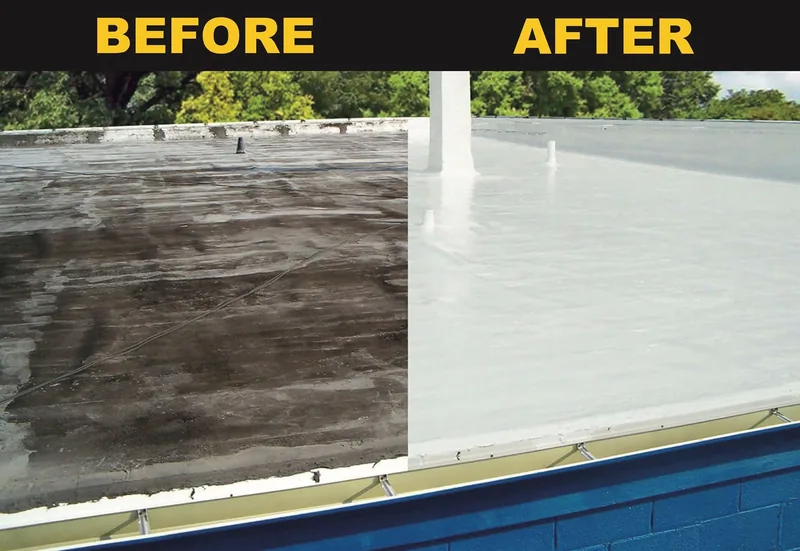
A coating is the most misused word in commercial roofing. Done properly it is a restoration — a documented sequence of cleaning, repair, reinforcement and controlled-thickness application that renews a sound roof and defers a replacement by years, at a fraction of the cost and without a single interior disruption. Done as a cheap coat of white paint sprayed over a dirty, leaking roof, it hides the problem until next spring and makes the eventual tear-off more expensive. The difference is entirely in the preparation and in one honest test: whether the insulation underneath is dry.
Is your roof actually a restoration candidate?
This is the only question that matters, and it gets answered with core cuts before anyone quotes a price.
Good candidates: the membrane or surfacing is weathered, chalking, losing granules or losing reflectivity, but intact; leaks are at seams, laps, flashings and penetrations rather than through a failed field; the insulation is dry, confirmed by core cuts and, on larger roofs, an infrared or moisture survey; the deck is sound; drainage functions or can be corrected; and the roof has not already been coated and neglected through a full cycle.
Poor candidates: wet insulation anywhere meaningful — a coating over saturated insulation seals water in, and the assembly rots quietly under a warranty you paid for; a deteriorating deck; membrane that is broadly brittle, shrinking, split or alligatored through; severe ponding that has not been corrected first; and a roof already at or past its structural service life.
We take cores, scan where it matters, and show you photographs. If your roof is not a candidate we will tell you so, because a failed coating is worse for you than a replacement and worse for us than the job we did not sell.
What a real restoration involves
Sequence, with the cost concentrated in the first four steps rather than the last one:
- Assessment — core cuts, moisture survey, drainage review, defect inventory, photographs.
- Repair — wet insulation cut out and replaced, splits and blisters repaired, failed flashings rebuilt, fasteners replaced on metal, drainage corrected.
- Cleaning — pressure washing and degreasing to a surface the coating will actually bond to. Adhesion failures almost always trace to this step being rushed.
- Priming where the substrate requires it, which varies by membrane type and by coating chemistry.
- Reinforcement — polyester fabric embedded in mastic over every seam, lap, penetration, curb, drain and transition. This is where a restoration earns its warranty.
- Base and top coats applied at specified dry film thickness, verified with wet-mil gauges as work proceeds, not estimated afterward.
- Documentation — material quantities used, thickness records, photographs, and the manufacturer warranty registration.
Ask any bidder for the specified dry film thickness and the quantity of material it requires per square. A bid that cannot answer is pricing a thinner roof than the one you think you are buying.
Silicone, acrylic or urethane
Three chemistries with genuinely different strengths, and the right one is a per-roof decision.
- Silicone — the workhorse in this region. Outstanding UV resistance and the best tolerance for ponding water of the three, cures in humidity, and holds up over decades. It stays slick when wet, attracts dirt over time (reducing reflectivity somewhat), and future recoats must be silicone, since little else bonds to it.
- Acrylic — water-based, economical, highly reflective, and pleasant to work with. It needs a proper cure window with no rain and temperatures above about 50 degrees, and it does not tolerate standing water — it will re-emulsify in ponding areas. Excellent on well-draining roofs and on metal.
- Urethane — the toughest surface, with real impact and foot-traffic resistance. Often used as a top coat over a base, or on roofs with heavy rooftop service traffic. Higher cost and more sensitive application.
In practice: chronic ponding or a humid schedule points to silicone; a well-drained roof on a budget points to acrylic; heavy foot traffic points to urethane or a granulated top surface.
Restoring each system we work on
- TPO — a weathered membrane with a dry assembly restores well; probe and repair welds first, and prime per the coating manufacturer.
- EPDM — chalking rubber takes a formulated system well, but requires the correct primer; seams get reinforced as a matter of course.
- PVC — restorable with compatible systems; compatibility is not optional here.
- Modified bitumen — one of the best-value restorations in roofing, and timing is everything: coat a granule-losing surface before it cracks through, not after.
- Built-up — smooth and cap-sheet BUR restore well with sound plies; gravel-surfaced roofs need the aggregate addressed first and are often not practical.
- Metal — arguably the best substrate of all, because coatings fix exactly what metal suffers: fasteners, laps, surface rust and heat gain.
- Spray foam — recoating is not optional maintenance on foam, it is the system requirement, roughly every 10 to 20 years.
The economics, and the accounting question worth asking
Restoration typically costs a fraction of tear-off and replacement, and the savings are not only in materials. There is no tear-off, so no interior exposure, no dumpsters and crane staging for days, no disruption to tenants or operations, and no landfill volume — the existing roof stays in place.
The point many owners miss: a restoration is often treated as maintenance or repair rather than a capital improvement, which changes how it hits a budget and a tax position entirely differently than a replacement does. That is a question for your accountant, not your roofer, and we are not offering tax advice — but it is worth asking, because it is frequently the difference between a project approved this year and a project deferred until the roof fails.
For a property manager running a portfolio, restorations are the highest-leverage line items in a capital plan: each one defers a replacement by years and smooths the spending curve. See property management.
Warranties and what they actually cover
Manufacturer restoration warranties commonly run 10, 15 or 20 years, and the term is driven mostly by dry film thickness — more material, longer warranty. Understand what you are getting:
- Material-only warranties cover the coating product. Labor to fix a failure is yours.
- Labor and material (NDL-style) warranties cover both, cost more, and require a manufacturer-approved applicator and an inspection at completion.
- Nearly all of them require documented maintenance and prompt reporting of damage. A roof with no inspection history is an easy denial.
- They cover the coating, not the roof under it. If the substrate fails because wet insulation was coated over, that is not a warranty claim — which is why the core cuts at the front end matter so much.
Our own lifetime workmanship warranty stands behind our installation work alongside whatever the manufacturer provides. And when the honest answer is that a coating will not serve you, we say so before you buy one.
Maintenance and the recoat cycle
A restored roof is not finished, it is renewed — and renewable again. Coatings weather and thin, and a roof that is recoated on cycle can be extended repeatedly. Silicone systems typically run the longest between recoats; acrylics need attention sooner, especially in ponding areas.
Maintenance is the same discipline as any other commercial roof: two inspections a year plus post-storm checks, drains and scuppers cleared, reinforced details examined, coating thickness and wear assessed particularly at traffic routes and ponding areas, punctures repaired, and a dated photographic report filed each visit for your warranty file.
Also: coordinate other trades. A coated roof is easy to damage with dragged equipment and dropped tools, and HVAC, solar and sign work that penetrates a restoration without proper flashing undoes it and can void the warranty.
Restoration work across our markets
Warehouses and distribution, manufacturing, retail centers, office buildings, schools and municipal facilities, churches, apartment and condominium property, self-storage, hospitality, and metal buildings of every kind — anywhere an owner is facing a replacement quote on a roof that may not actually need replacing.
Warehouse, distribution and industrial restorations lead volume around St. Louis, Kansas City and Indianapolis; metal building and agricultural restorations dominate around Springfield, Columbia and Jefferson City and across Metro East and Southern Illinois; and hospitality, retail and condominium restorations lead at the Lake of the Ozarks, where closing a building for a tear-off is rarely an option.
Our seven local markets — 143 cities
We install and service coating and restoration systems from seven local offices covering 143 cities in Missouri, Kansas, Illinois and Indiana. Each market runs its own crews and its own number — call the office nearest the building.
Questions, answered
Tap any question to open it.
What is a roof coating or roof restoration?
A restoration cleans and repairs your existing roof, reinforces every seam, lap, penetration and flashing with polyester fabric embedded in mastic, then applies a silicone, acrylic or urethane coating at a specified thickness — creating a seamless, reflective, waterproof surface over the roof you already have, with no tear-off.
Can I coat my roof instead of replacing it?
If the insulation underneath is dry, the deck is sound, and the membrane is weathered but intact, usually yes — and it typically costs a fraction of replacement. Core cuts and a moisture survey answer that before anyone quotes a price. If the insulation is wet, a coating seals the water in and makes things worse.
How do you know if my insulation is wet?
Core cuts, which physically open the assembly and show what is in it, plus infrared or moisture scanning on larger roofs to map saturated areas. We photograph what we find. Anyone quoting a coating without testing this is guessing with your money.
How long does a roof coating last?
Manufacturer restoration warranties commonly run 10, 15 or 20 years, and the term is driven mostly by dry film thickness — more material, longer warranty. Recoated on cycle, a restored roof can be renewed repeatedly. Silicone generally goes longest between recoats.
Silicone or acrylic — which is better?
Silicone tolerates ponding water and ultraviolet exposure best and cures in humidity, which makes it the workhorse in this region; future recoats must also be silicone. Acrylic is economical and highly reflective but will re-emulsify in standing water and needs a proper dry cure window. We specify per roof, not per product line.
Will a coating stop my roof from leaking?
It stops leaks that come from the surface, seams, laps, flashings and penetrations, provided those are properly repaired and reinforced first. It will not fix a leak from a failed deck, a structural problem, or water already trapped in the insulation — those are repaired before any coating goes on.
How much does a roof coating cost?
Typically a fraction of tear-off and replacement, but it varies with square footage, coating chemistry, specified dry film thickness, how much repair and wet insulation removal is needed up front, the number of penetrations and details to reinforce, and access. The assessment and written itemized scope are free.
Why are coating bids so different from each other?
Almost always dry film thickness and preparation. A thin coat sprayed over a dirty roof with no fabric reinforcement prices very low and fails early. Ask every bidder for the specified dry film thickness, the material quantity per square that implies, and exactly which details get fabric and mastic.
Is a roof coating a maintenance expense or a capital improvement?
It is frequently treated as maintenance or repair rather than a capital improvement, which affects a budget and a tax position very differently than a replacement — and it is often the difference between approval this year and deferral. That question belongs to your accountant; we are not giving tax advice, but it is worth asking.
Can you coat a roof that holds water?
Silicone tolerates ponding far better than acrylic, but ponding should be corrected rather than coated over — standing water 48 hours after rain shortens the life of any system, adds structural load and can void a warranty. Tapered insulation, added drains or spray foam build the slope the roof lacks.
Which roof systems can be coated?
TPO, EPDM, PVC, modified bitumen, smooth and cap-sheet built-up, metal and spray foam — each with its own primer and preparation requirements. Metal is arguably the best substrate of all, because coatings fix exactly what metal suffers from. Gravel-surfaced built-up roofs are usually not practical candidates.
Will a coating lower my energy costs?
A reflective coating reduces surface temperature substantially and cuts cooling load, which on a large-footprint building through a Midwest summer is a real number. It does not replace insulation — R-value does that — so on a poorly insulated building, insulation does more than surface color.
Does the building have to close during a restoration?
No, and that is one of the main reasons owners choose it. There is no tear-off, so no interior exposure, no open roof, and far less staging and noise than a replacement. We schedule around your operation and coordinate access, and occupied buildings stay open throughout.
Where do you do roof coating and restoration work?
143 cities across Missouri, Kansas, Illinois and Indiana from seven local offices: St. Louis, Kansas City, Indianapolis, Springfield, Columbia and Jefferson City, the Lake of the Ozarks, and Metro East and Southern Illinois.
Other commercial systems we install
Back to commercial & specialty roofing, or see property management, storm damage and roof insurance claims.
Where we work
The Best Value Guarantee
Bring us a qualifying written estimate from a qualifying contractor and we will compare it against ours. If we can match or improve the value, you agree to let us do the work. If we decide not to match or improve it, we refund your deposit and pay you an additional $200 — in writing.