
Home › 24/7 Emergency Roof Repair & Tarp Service
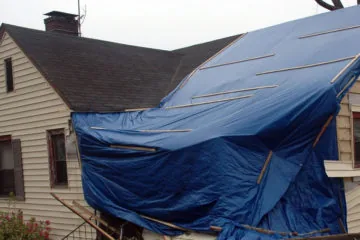
24/7 emergency roof repair & emergency tarp service
Water is coming into the building and the next band of rain is on the way. That is the situation this page is written for. Call the number below — a person answers, at any hour, in every market we serve — and read the first section while you wait.
Call now — and what to do in the next ten minutes
A real person answers, at any hour, in every market we serve. Make the call first, then use the time before we arrive to limit the damage.
Do these things
- Get everyone away from the affected area. A sagging or stained ceiling can come down without warning.
- Kill power to the affected rooms at the breaker if water is anywhere near fixtures, outlets or the panel. Water and electricity is the part of this that actually hurts people.
- Move what you can — furniture, electronics, anything on the floor beneath the leak.
- Catch the water in buckets or totes, and put towels under them to stop splash spread.
- Relieve a bulging ceiling. If drywall is sagging with trapped water, a small hole at the low point, with a bucket under it, drains it in a controlled way instead of letting the whole section collapse.
- Photograph and video everything before you clean up — the ceiling, the walls, the floor, the contents, and anything visible outside from ground level. Time-stamped photos taken during the event are worth far more to your claim than photos taken after cleanup.
- Call your insurance carrier and open a claim.
Do not do these things
- Do not get on the roof. Not in the rain, not in wind, not at night, not to look, not to put a tarp down yourself. Wet roofs and storm debris are how people end up in the hospital, and a homeowner falling is far more expensive than any roof.
- Do not sign anything a door-knocker hands you in the hours after a storm, including an "authorization to inspect."
- Do not let anyone offer to cover your deductible. It is illegal in Missouri and Illinois.
Emergency tarp service — stopping the water tonight
Tarping is the single most important thing that happens in the first 24 hours after a roof fails. It is not a repair — it is a controlled, weather-tight cover that stops water entering the building while the permanent fix gets scoped, approved and scheduled.
What a professional tarp actually is
There is a real difference between a tarp thrown over a roof and weighted with bricks, and a tarp installed properly. Done right, it involves:
- Heavy-duty reinforced poly, sized to run well past the damage on all sides and lap over the ridge where the damage is near the top, so water cannot run underneath the upper edge.
- Anchored edges — typically wrapped and fastened to furring strips, so the fasteners bear on wood rather than tearing straight through the tarp in the next wind event.
- Fasteners placed to be sealed later, not driven randomly through sound shingles that then need replacing.
- Water directed off the roof and away, rather than into a valley or a dead pocket.
- Open penetrations and missing components — a blown-off vent, a displaced pipe boot, a hole from a limb — addressed individually rather than just draped.
A tarp that fails in the next storm is worse than no tarp at all, because the owner stops watching. Ours are installed to hold until the permanent repair is done.
Also part of emergency stabilization
- Board-up of holes punched by limbs or debris.
- Shrink-wrap or mechanically fastened systems on large commercial areas, complex roof lines, or where a tarp needs to hold for an extended period through a long claim.
- Debris removal where a limb or structure is still resting on the roof.
- Interior protection where water is still moving through the building.
What counts as a roofing emergency
If water is coming in, it is an emergency. Beyond that, call immediately for any of these:
- Active leaking during or after rain, at any volume.
- A tree limb or debris on the roof, or a hole punched through the deck.
- Shingles, panels or an entire roof section blown off by wind.
- A ceiling that is sagging, bulging or staining and spreading.
- Missing or displaced flashing, vents, pipe boots or ridge cap after a storm.
- Hail that has clearly bruised or fractured the surface, particularly with rain forecast behind it.
- A commercial membrane that has lifted, torn or peeled back, or blocked drains holding water on a flat roof.
- Any storm damage with more rain in the forecast — the second storm is the one that ruins the ceiling.
When in doubt, call. There is no charge for asking, and it costs nothing to have someone who does this for a living tell you whether it can wait until morning.
Commercial emergency response
For a commercial building the clock runs on operations as much as on the roof: inventory, tenants, equipment, data, and the liability of a wet floor in an occupied space.
We respond to commercial roof emergencies across every market, on low-slope and steep-slope alike — membrane tears and lifted laps on TPO, EPDM and PVC, split and blistered modified bitumen and built-up roofs, storm-displaced metal panels, blocked drains and ponding after heavy rain, and wind-lifted edge metal and coping.
We work around your operation, coordinate with facility staff and tenants, document everything for the carrier, and for multi-building portfolios we prioritize across the whole property rather than treating each address as a separate call. See commercial roofing and property management.
Does insurance pay for emergency tarping?
Usually, yes — and this surprises people.
Most property policies contain a duty to mitigate: the policyholder is expected to take reasonable steps to prevent further damage after a loss. Emergency tarping is the textbook example, and reasonable emergency mitigation costs are typically reimbursable, frequently without waiting for the full claim to settle.
The reverse is also true, and it is why this matters: if you do nothing and the next storm soaks the interior through an opening that could have been covered, a carrier can decline the additional damage as preventable. Tarping protects the claim as much as it protects the building.
How to protect your reimbursement
- Report the loss promptly and tell the carrier you are having the roof covered.
- Keep documentation — our invoice, our photographs, and the dates.
- Photograph the damage before the tarp goes on, and the tarp once it is installed.
We document every emergency call with dated photographs and provide an itemized invoice written the way adjusters expect to read it. We are not giving you a coverage opinion — your policy and your adjuster decide — but we have handled this thousands of times and we will make sure nothing is missing on our end. See roof insurance claims.
Temporary stabilization vs. the permanent repair
These are two separate jobs and it helps to think of them that way.
Tonight's job is stopping water. Fast, weather-tight, good enough to hold through the next several storms.
The real job comes after: a full inspection in daylight, a written itemized scope, the insurance claim if there is one, material selection and ordering, and a scheduled repair or replacement done properly. Rushing that work in the dark, in the rain, produces a roof that leaks again in a year.
How long a tarp should stay on depends on the claim, the material lead time and the weather window — weeks is normal, and through a complex commercial claim it can be longer. If it needs to hold a while, we install it to hold a while, and we come back and check it.
From there the path is roof repair or roof replacement, with storm damage and the claim handled alongside.
Why 24/7 actually matters in this region
Midwest storms do not arrive during business hours. The classic pattern here is a line that develops in the late afternoon, matures after dark, and hits between 10 p.m. and 3 a.m. — and the second wave often follows the same night or the next afternoon. The gap between those two is the entire window in which a tarp saves your ceiling.
Our founder built the company on answering that call. When a storm hits at 2 a.m., someone picks up the phone. That is not a marketing line, it is the operating model, and it is why the line is staffed in every market rather than routed to a voicemail box that gets checked at eight.
An honest word about big events. After a major regional hail or wind event, thousands of properties are damaged at once and no roofing company in the country tarps them all the same night. When that happens we triage by severity — active interior water and open holes first, cosmetic damage later — and we tell you where you are in the queue rather than promising a time we cannot hold. You will get a straight answer.
What you will not get: an out-of-state crew that arrived with the storm and will be gone by spring. We have been here since 1947, with local offices, in-house crews and an address you can drive to. See our BBB Torch Award and lifetime workmanship warranty.
Emergency roof repair and tarp service in every market we serve
St. Louis — 314-429-6000
Emergency roof repair and tarping across the St. Louis metro — the city, St. Charles, St. Peters, O'Fallon, Chesterfield, Wildwood, Ballwin, Kirkwood, Webster Groves, Florissant, Hazelwood, Maryland Heights, Bridgeton, Creve Coeur, Arnold, Fenton, Wentzville and the surrounding communities. Our headquarters is here at 12181 Prichard Farm Road in Maryland Heights, which means crews, materials and tarps are staged locally rather than dispatched from another state after the storm clears. See our St. Louis market page.
Kansas City — 816-572-9500
Emergency response on both sides of the state line. Missouri side: Kansas City, Independence, Lee's Summit, Blue Springs, Liberty, Gladstone, Raytown, Grandview and Belton — call 816-572-9500. Kansas side: Overland Park, Olathe, Lenexa, Shawnee, Leawood, Prairie Village and Kansas City, KS — call 913-281-6000. Kansas City sits in one of the most active hail corridors in the country, and spring events here routinely produce wind-driven rain behind the hail. See our Kansas City market page.
Indianapolis — 317-726-6000
Emergency roof repair and tarp service across Indianapolis and the surrounding communities — Carmel, Fishers, Noblesville, Westfield, Greenwood, Avon, Plainfield, Brownsburg, Zionsville, Lawrence and Speedway. Central Indiana takes both straight-line wind events and hail, and the derecho-type wind that moves through this corridor peels shingles and lifts ridge lines across whole neighborhoods at once. See our Indianapolis market page.
Springfield, MO — 417-429-1927
Emergency service across Springfield, Nixa, Ozark, Republic, Branson, Bolivar, Rogersville, Willard and the greater southwest Missouri Ozarks. This corner of the state sits where Plains storm systems mature, and it sees some of the largest hail in Missouri along with the wind that follows it. See our Springfield, MO market page.
Columbia & Jefferson City — 573-343-8993
Emergency roof repair and tarping in Columbia, Jefferson City, Fulton, Ashland, Boonville, Moberly, Mexico and the mid-Missouri corridor. Storms crossing the state along the I-70 corridor often arrive here at full strength, and mid-Missouri's mix of older housing stock and newer subdivisions means we tarp everything from century-old homes to two-year-old builds. See our Columbia & Jefferson City market page.
Lake of the Ozarks — 573-343-8993
Emergency service throughout the Lake area — Osage Beach, Camdenton, Lake Ozark, Linn Creek, Sunrise Beach, Eldon, Laurie and Village of Four Seasons. Lake property brings its own emergency profile: steep and complex roof lines, large second homes that may be unoccupied when the storm hits, condominium and resort buildings, and owners who are often two hours away when a neighbor calls to say shingles are in the driveway. We will go look and we will tarp it before the next round of rain. See our Lake of the Ozarks market page.
Metro East & Southern Illinois — 618-549-0800
Emergency roof repair and tarping across the Metro East and southern Illinois — Belleville, O'Fallon, Edwardsville, Glen Carbon, Collinsville, Granite City, Alton, Godfrey, Highland, Waterloo, Columbia, Carbondale, Marion and Mount Vernon. Southern Illinois takes the tail end of systems that cross the Mississippi and frequently sees the strongest wind in the region. See our Metro East & Southern Illinois market page.
24/7 emergency roof repair near you — pick your market
Every market below has its own local crew, local phone number and 24/7 emergency tarp service. Choose the one closest to you:
- 24/7 emergency roof repair & tarping in St. Louis
- 24/7 emergency roof repair & tarping in Kansas City
- 24/7 emergency roof repair & tarping in Indianapolis
- 24/7 emergency roof repair & tarping in Springfield
- 24/7 emergency roof repair & tarping in Columbia
- 24/7 emergency roof repair & tarping in Jefferson City
- 24/7 emergency roof repair & tarping in Lake of the Ozarks
- 24/7 emergency roof repair & tarping in Farmington
- 24/7 emergency roof repair & tarping in Cape Girardeau
- 24/7 emergency roof repair & tarping in Carbondale
- 24/7 emergency roof repair & tarping in Paducah
Questions, answered
Tap any question to open it.
Who do I call for emergency roof repair right now?
Call John Beal Roofing at 1-800-564-6232, or your local office directly — St. Louis 314-429-6000, Kansas City MO 816-572-9500, Kansas City KS 913-281-6000, Indianapolis 317-726-6000, Springfield MO 417-429-1927, Columbia and Jefferson City 573-343-8993, Lake of the Ozarks 573-343-8993, Metro East and Southern Illinois 618-549-0800. A person answers 24 hours a day.
Do you offer emergency roof tarping?
Yes. Emergency tarping is the core of our after-hours service: a heavy-duty reinforced tarp sized past the damage, lapped over the ridge where needed, anchored to furring strips so it holds in wind, with water directed off and away from the building. We also board up holes and shrink-wrap larger or longer-term areas.
Will my insurance pay for an emergency tarp?
Usually. Most property policies include a duty to mitigate — you are expected to take reasonable steps to prevent further damage — and emergency tarping is the standard example, often reimbursable without waiting for the full claim to settle. Keep the invoice and photographs, and report the loss promptly.
What happens if I do not tarp my roof after a storm?
Beyond the additional water damage, a carrier can decline damage that occurred because an opening was left uncovered when covering it was reasonable. Tarping protects the claim as much as it protects the building.
How fast can you get here?
We answer live at any hour and dispatch as quickly as conditions and the queue allow. After a major regional hail or wind event, thousands of properties are hit at once — we triage by severity, active interior water and open holes first, and we tell you honestly where you are in line rather than promising a time we cannot hold.
Do you do emergency roof repair at night?
Yes, we answer and dispatch around the clock. What gets done in the dark is stabilization — tarping, board-up, stopping water. Full inspection and permanent repair happen in daylight, when they can be done correctly and safely.
Should I put a tarp on my own roof?
No. Do not get on a wet, damaged or storm-debris-covered roof, in the dark or otherwise. Homeowner falls are the most serious injuries that come out of storms, and an improperly anchored tarp usually blows off in the next wind and can pull shingles with it.
What should I do while waiting for the crew?
Keep everyone clear of the affected area, shut off power to rooms where water is near fixtures or outlets, move furniture and electronics, catch water in buckets, relieve a bulging ceiling with a small hole at the low point over a bucket, photograph everything before cleaning up, and call your insurance carrier.
My ceiling is bulging with water. What do I do?
Keep everyone out from under it and relieve the pressure with a small hole at the lowest point of the bulge, with a bucket underneath. Draining it in a controlled way is far better than letting a saturated section of drywall collapse on its own.
How much does emergency tarping cost?
It depends on the size and pitch of the area, the complexity of the roof, access, and how long the cover has to hold. We give you the number before we start, in writing, and because tarping is usually reimbursable mitigation we document it the way adjusters expect to see it.
How long can a tarp stay on my roof?
Weeks is normal while a claim is processed and materials are ordered, and a complex commercial claim can run longer. We install to the timeline the job actually needs and come back to check it — a tarp that fails in the next storm is worse than no tarp, because you stop watching.
Do you provide emergency roof repair in St. Louis?
Yes — 314-429-6000, across the city, St. Charles, St. Peters, O'Fallon, Chesterfield, Kirkwood, Webster Groves, Florissant, Maryland Heights, Arnold, Fenton, Wentzville and the surrounding metro. Our headquarters is in Maryland Heights, so crews, materials and tarps are staged locally.
Do you provide emergency roof repair in Kansas City?
Yes, on both sides of the state line. Missouri side call 816-572-9500 for Kansas City, Independence, Lee's Summit, Blue Springs and Liberty. Kansas side call 913-281-6000 for Overland Park, Olathe, Lenexa, Shawnee and Leawood.
Do you provide emergency roof repair in Indianapolis?
Yes — 317-726-6000, serving Indianapolis, Carmel, Fishers, Noblesville, Westfield, Greenwood, Avon, Plainfield, Brownsburg and Zionsville, including the straight-line wind events that strip shingles across whole neighborhoods in central Indiana.
Do you provide emergency roof service at the Lake of the Ozarks?
Yes — 573-343-8993, throughout Osage Beach, Camdenton, Lake Ozark, Linn Creek, Sunrise Beach, Eldon and Laurie. We regularly handle second homes and condominium buildings whose owners are hours away, going out to look and tarping before the next round of rain.
Do you provide emergency roof repair in Springfield, Columbia, Jefferson City or southern Illinois?
Yes. Springfield and the southwest Missouri Ozarks: 417-429-1927. Columbia, Jefferson City and mid-Missouri: 573-343-8993. Metro East and southern Illinois including Belleville, Edwardsville, Collinsville, Alton, Carbondale and Marion: 618-549-0800.
Do you handle commercial roof emergencies?
Yes, on low-slope and steep-slope alike — membrane tears and lifted laps on TPO, EPDM and PVC, split modified bitumen and built-up roofs, displaced metal panels, blocked drains and ponding, and wind-lifted edge metal. We work around your operation and document everything for the carrier.
Is the emergency call itself free?
Yes, asking costs nothing. Call and describe what you are seeing and we will tell you honestly whether it needs someone tonight or whether it can safely wait until morning. Any work we perform is quoted before we begin.
Is a tarp a repair?
No. A tarp is controlled stabilization that stops water entering while the permanent fix is inspected in daylight, scoped in writing, run through insurance if applicable, and scheduled properly. Rushing permanent work in the dark and the rain produces a roof that leaks again.
Should I sign anything a contractor hands me right after a storm?
No. Do not sign in the hours after a storm, including an authorization to inspect, which is sometimes a binding contract with a cancellation penalty. And never accept an offer to waive, absorb or rebate your deductible — that is illegal in Missouri and Illinois.
Does storm damage go through insurance or your warranty?
Insurance. Hail, wind beyond your shingle's rating, tornado, lightning and falling limbs are not installation defects, so no roofing workmanship warranty covers them. We inspect, document the damage with dated photographs and meet your adjuster at the property.
Where do you provide 24/7 emergency roof service?
Across 500+ cities in Missouri, Kansas, Illinois, Indiana and Kentucky from ten local offices: St. Louis, Kansas City on both sides of the state line, Indianapolis, Springfield, Columbia and Jefferson City, the Lake of the Ozarks, and Metro East and Southern Illinois.