
Home › Commercial Roofing › TPO roofing — the reflective single-ply workhorse
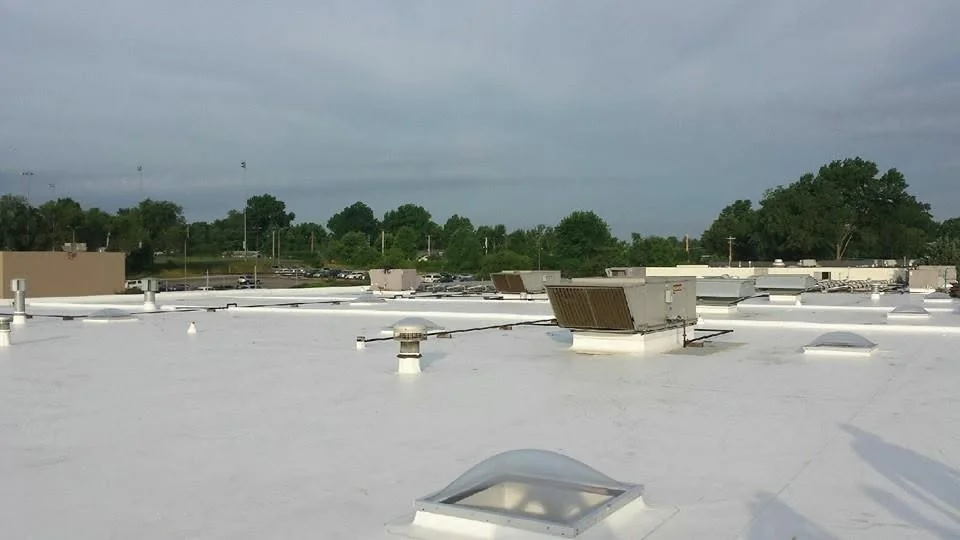
TPO roofing — the reflective single-ply workhorse
TPO is the most commonly installed commercial roof in the Midwest right now, and for good reason: the seams are hot-air welded rather than glued, so a correctly welded seam is stronger than the membrane itself, and the reflective white surface cuts cooling load on a building with a lot of square footage under it. It is also the system where installation quality matters most — a TPO roof is essentially a field of welds, and welds are a workmanship question, not a materials question.
What TPO is and how it goes on
TPO is a thermoplastic single-ply membrane, typically 45, 60 or 80 mil, supplied in rolls wide enough to keep seam count down. Thermoplastic is the important word: it can be re-melted, so seams are joined with hot air into a single continuous sheet, and a repair years later welds into the original membrane rather than sitting on top of it.
Three attachment methods, chosen by building and wind-uplift requirement:
- Mechanically attached — plates and fasteners through the membrane into the deck along seam lines. Fastest and most economical; slight flutter in wind is normal.
- Fully adhered — bonded across the entire surface. Cleaner appearance, better wind performance, higher cost.
- Induction welded — plates set under the membrane and heat-bonded through it, so no fasteners penetrate the sheet.
Under the membrane: deck, insulation (usually polyiso, often tapered to build slope), and a cover board that protects against hail and foot traffic. The cover board is the item value-engineered out of cheap bids, and it is the item that decides whether a hailstorm cracks your roof.
Why building owners here choose TPO
- Welded seams — the strongest part of the roof when done right, with no adhesive to age out.
- Reflectivity — the white surface meaningfully reduces cooling load on a big-footprint building through a Missouri or Kansas August.
- Cost — generally the best price per square foot among new single-ply systems.
- Weight — light enough for most existing structures without structural work.
- Repairability — a new patch welds to old membrane, with no compatibility fight a decade later.
Where TPO is the wrong answer: heavy grease or animal-fat exposure, where PVC is correct; roofs with very heavy foot traffic and complex penetrations, where modified bitumen holds up better; and roofs where ponding is severe enough that spray foam or tapered work should solve the slope first.
How long TPO lasts in the Midwest
A well-installed TPO roof over a sound assembly generally runs 20 to 30 years, with 60 mil the common specification and 80 mil the choice where hail and foot traffic argue for more. What moves that number, in order: weld quality, whether a cover board was installed, drainage, and whether anyone maintains it.
Our climate is hard on membranes in a specific way, and it is not the heat — it is thermal cycling. A roof in St. Louis or Kansas City can swing more than 100 degrees between a January night and a July afternoon surface temperature, and every cycle works the seams, terminations and fasteners. That is why edge metal, coping and terminations fail before the field of the roof does, and why an annual look at the perimeter is worth more than an annual look at the middle.
Hail, wind and TPO
Hail damage on TPO is frequently invisible from a walk-by and routinely underpaid on claims. Impact can fracture the membrane's reinforcing scrim beneath an intact-looking surface, or crush the insulation below it, leaving a roof that reads fine this year and leaks in two. A cover board is the best defense, and its presence or absence often decides the outcome of a hailstorm.
Wind damage shows up at the perimeter almost every time: lifted or peeled membrane at the edge, failed termination bars, displaced coping and edge metal, and billowing on mechanically attached systems where fastener rows were spaced for a lower uplift category than the building actually needs. Perimeter and corner zones require tighter attachment than the field — that is code, and it is skipped more often than owners would believe.
We document hail with a test-square methodology an adjuster can follow, photograph corroborating soft-metal damage, and take core cuts where the question is wet insulation. See storm damage and roof insurance claims.
Common TPO failures and how we repair them
- Open or cold-welded seams — a welding speed or temperature issue at install, found later by probe
- Failed pipe boots and penetration flashings, the most common leak source on any single-ply roof
- Punctures from dropped tools, HVAC service traffic, debris and hail
- Failed pitch pockets around irregular penetrations
- Curb and skylight flashings at mechanical equipment
- Loose termination bars and edge metal at parapets and perimeters
- Clogged drains and scuppers causing ponding and vegetation
- Shrinkage at corners on older roofs, pulling membrane from vertical terminations
Repairs weld new membrane into the original sheet. Where a roof has broad surface weathering but a dry assembly underneath, a restoration coating is often a better economic answer than a tear-off.
Repair, restore or replace
Repair when the assembly is dry and failures are isolated — seams, boots, punctures, flashings. This is the right answer far more often than owners are told.
Restore when the membrane is weathered and near the end of its surface life but the insulation is dry and the deck sound. A fluid-applied coating adds years at a fraction of replacement cost, often as a maintenance expense rather than a capital one.
Replace when moisture scanning or core cuts show wet insulation across a meaningful area, the deck is deteriorating, the membrane is broadly brittle or shrinking, or the roof has already been restored once.
The decision should rest on evidence: core cuts showing the real assembly and whether insulation is saturated, infrared or moisture scanning to map wet areas, and a drainage review. We report what we find with photographs, including when the finding is that you do not need what we sell.
Maintenance that actually extends a TPO roof
Two inspections a year plus a post-storm check, and the roof outlives its warranty. Skip it and it does not. A program covers drains and scuppers cleared, debris removed, seams probed, terminations and edge metal checked, pipe boots and pitch pockets examined, penetrations by other trades documented, minor repairs made on the spot, and a photographic report filed after each visit.
That report also protects your warranty. Most manufacturer system warranties require documented maintenance and prompt reporting of damage, and a roof with no inspection history gives a carrier or manufacturer an easy reason to challenge a claim. Damage caused by other trades — uncoordinated HVAC, solar, satellite or sign work penetrating your membrane — is the other common way coverage quietly disappears.
Buildings we install TPO on, market by market
Warehouses and distribution centers, retail centers and strip malls, light industrial and manufacturing, office buildings, medical and dental offices, self-storage, auto dealerships, restaurants, schools and municipal facilities, and multi-family properties with low-slope sections.
What differs by market is mostly storm history and building stock. Distribution and light industrial dominate low-slope work around St. Louis, Kansas City and Indianapolis; hail claims drive a large share of volume in Springfield and across Metro East and Southern Illinois; and hospitality, retail and condominium work leads at the Lake of the Ozarks and through Columbia and Jefferson City.
Our seven local markets — 143 cities
We install and service TPO membrane roofs from seven local offices covering 143 cities in Missouri, Kansas, Illinois and Indiana. Each market runs its own crews and its own number — call the office nearest the building.
Questions, answered
Tap any question to open it.
What is TPO roofing?
TPO is thermoplastic polyolefin, a single-ply commercial roofing membrane with hot-air-welded seams and a reflective white surface, typically 45, 60 or 80 mil. It is installed mechanically attached, fully adhered or induction welded over insulation and a cover board, and it is the most commonly installed new commercial roof in the Midwest.
How long does a TPO roof last?
Generally 20 to 30 years when well installed over a sound, dry assembly. Weld quality, whether a cover board was installed, drainage and maintenance move that number far more than the brand of membrane does.
Is TPO better than EPDM?
Neither is better in the abstract. TPO has welded seams and a reflective surface that cuts cooling load; EPDM has the longest real-world track record in our climate and handles thermal cycling extremely well. TPO tends to suit large reflective-surface buildings, EPDM smaller and more complex roofs.
What thickness of TPO should I use?
60 mil is the common specification. 80 mil is worth the upgrade where hail is frequent, where there is regular rooftop foot traffic for HVAC service, or where you want the longest service life. 45 mil is the economy option and we rarely recommend it in hail country.
Does TPO hold up to hail?
Reasonably, and far better with a cover board underneath — the single most important hail decision on a TPO roof, and the item most often value-engineered out of a cheap bid. Hail can fracture the reinforcing scrim under an intact-looking surface, so damage is frequently invisible from a walk-by and routinely underpaid.
Can TPO be repaired?
Yes, and most TPO problems are repairable. Because TPO is a thermoplastic, new membrane heat-welds into the original sheet rather than being glued on top of it, so the repair becomes part of the roof. Seams, pipe boots, punctures, pitch pockets and flashings are all routine.
Can you coat a TPO roof instead of replacing it?
Often, if the membrane is fundamentally sound and the insulation underneath is dry. A coating adds years at a fraction of replacement cost and is frequently treated as maintenance rather than capital expense. If core cuts or an infrared scan show wet insulation, a coating just seals the water inside.
How much does a TPO roof cost?
It depends on square footage, membrane thickness, attachment method, tear-off versus overlay, insulation and cover board, deck condition, drainage corrections, penetrations and curbs, edge metal, access and staging, and phasing around your operation. The assessment and written itemized scope are free.
Can you install TPO over my existing roof?
Sometimes. Most jurisdictions limit a building to two roof layers, so if there are already two the code forces a tear-off. An overlay also requires a dry assembly and a sound deck — recovering a wet roof buys a short delay and a larger bill later.
Why is my TPO roof leaking at the edges?
Perimeter and corner zones take far more wind uplift than the field and require tighter attachment, so failures concentrate there: loose termination bars, failed edge metal and coping, membrane lifted at the perimeter. Thermal cycling works those details hard in our climate. Most of it is repairable.
Does a white TPO roof really lower energy costs?
It reduces cooling load, and on a large-footprint building through a Midwest summer that is a real number on the utility bill. It will not transform a poorly insulated building — R-value does that — which is why a re-roof is the right moment to correct insulation as well.
Do you offer TPO maintenance programs?
Yes, across all seven markets: two inspections a year plus post-storm checks, drains cleared, seams probed, terminations and flashings examined, minor repairs on the spot, and a photographic report after each visit for your records and warranty file.
Does insurance cover TPO hail damage?
Frequently. The difficulty is that TPO hail damage is hard to see, so it is commonly underpaid or missed. We document with a test-square methodology an adjuster can follow, photograph corroborating damage on soft metals and equipment, take core cuts where wet insulation is the question, and meet your adjuster at the building.
Where do you install TPO roofing?
143 cities across Missouri, Kansas, Illinois and Indiana from seven local offices: St. Louis, Kansas City, Indianapolis, Springfield, Columbia and Jefferson City, the Lake of the Ozarks, and Metro East and Southern Illinois.
Other commercial systems we install
Back to commercial & specialty roofing, or see property management, storm damage and roof insurance claims.
Where we work
The Best Value Guarantee
Bring us a qualifying written estimate from a qualifying contractor and we will compare it against ours. If we can match or improve the value, you agree to let us do the work. If we decide not to match or improve it, we refund your deposit and pay you an additional $200 — in writing.