
Tuesday night, October 13, 2026, a line of severe thunderstorms rolled across the Kansas City metro and left a mess behind it: trees across roads and yards, power lines on the ground, and tens of thousands of homes and businesses in the dark. The storms brought winds of more than 70 mph, heavy rain and frequent lightning, and the National Weather Service issued a tornado warning in Clay County along with several severe thunderstorm warnings across the metro. No tornadoes had been confirmed in the first reports.
The damage stretched from the Northland to Johnson County and east toward Ray County. If you live in Parkville, Weatherby Lake, Gladstone, Liberty or anywhere along that path, your roof took the same wind that snapped the trees on your street. Here is what was reported, what wind and falling trees do to a roof, and how to decide between emergency tarping, a repair and a replacement.
What was reported across the Kansas City metro on October 13
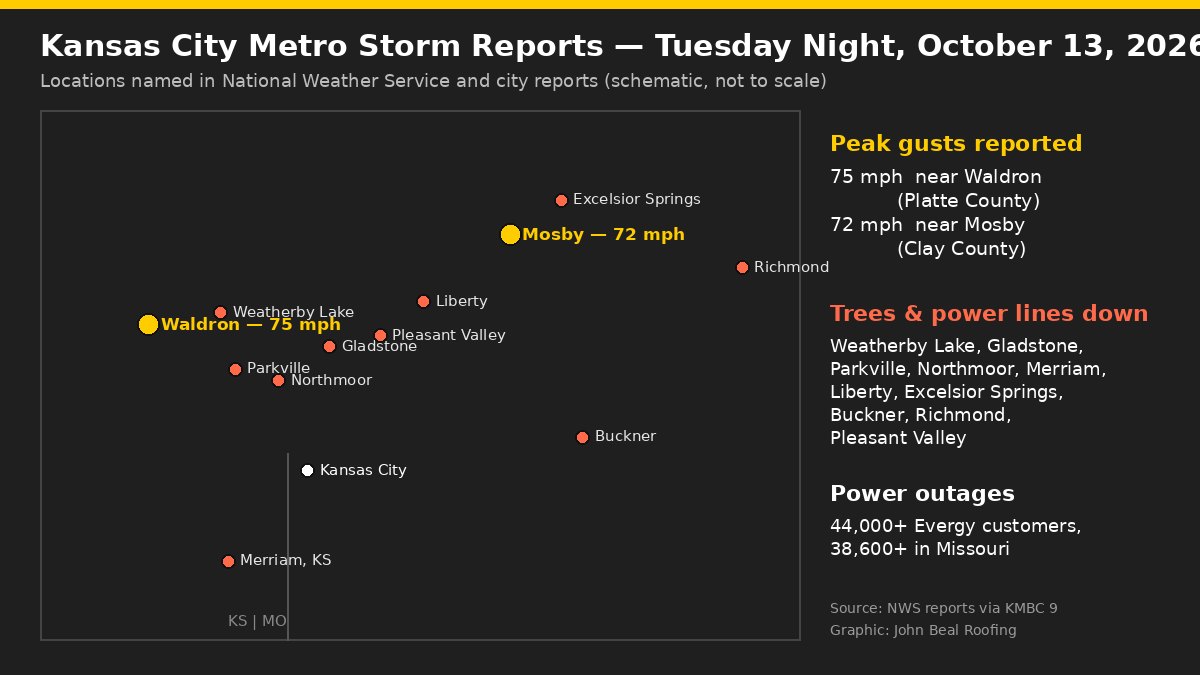
The strongest measured gusts came out of the Northland: 75 mph near Waldron in Platte County and 72 mph near Mosby in Clay County. The National Weather Service also received reports of trees and power lines down in Merriam, Parkville, Northmoor, Liberty, Excelsior Springs, Buckner and Richmond. KMBC 9 reported a large pear tree down across Potomac Avenue in Weatherby Lake, bringing power lines with it and closing the road; neighbors said part of the same tree had already come down in storms back in June. Gladstone saw large trees down and widespread outages.
Evergy reported more than 44,000 customers without power Tuesday night, over 38,600 of them in Missouri, with Kansas City, Gladstone, Liberty and Parkville among the hardest-hit communities. The City of Parkville reported a large tree blocking 7th Street just west of Main Street and another tree in the power lines on 8th Street. Pleasant Valley police warned of fallen trees, branches and debris across the city, and the City of Liberty reported downed lines and traffic signals out, asking residents to stay at least 30 feet from any downed line.
What 70+ mph wind and falling trees actually do to a roof
Wind damages a shingle roof in three ways, and only one of them is obvious from the street.
- Broken seal strips. Every architectural shingle is glued to the course below by a factory adhesive strip. Gusts in the 70s lift the tabs, break that bond and let the shingle lie back down looking fine. An unsealed shingle is the one that blows off in the next storm, and it lets wind-driven rain work underneath.
- Creased shingles. When a tab flaps hard enough, it bends at the nail line and leaves a horizontal crease. The mat is cracked there even if the shingle stays on, and creases are a standard item an adjuster looks for.
- Blow-offs and lifted edges. Missing shingles, exposed underlayment, loose ridge caps, lifted drip edge and pulled flashing at walls and chimneys are the visible damage. Ridges, rakes and corners take the strongest uplift, so that is where it shows first.
Falling trees are a separate and more urgent problem. A large limb can puncture the decking, crack rafters and leave an open hole in the roof, and even a smaller branch dragged across the roof by wind can scrape granules and tear shingles. With trees reported down across the Northland and beyond, homes near mature trees deserve a careful look even if nothing seems to have hit the house.
When a tree or large limb hits your roof
- Get people out of the rooms under it. A sagging or cracked ceiling can come down without warning, especially once insulation and drywall soak up water.
- Treat every wire as live. Stay away from any power line tangled in the tree and report it to Evergy or 911. Liberty asked residents to keep at least 30 feet from downed lines, which is good advice everywhere.
- Do not climb up or cut it yourself. A tree resting on a roof is often holding weight in ways that are not obvious, and cutting it can drop it further into the house.
- Photograph everything first from the ground and inside, before anything is moved.
- Call for emergency tarping. Once the tree is safely off, the opening needs to be covered before the next rain. We coordinate with tree crews so the roof is tarped the moment the limb is clear.
What you can safely check from the ground in 64152 and across the metro
Stay off the roof; a wet, debris-covered roof is dangerous, and most of what you need is visible from the yard.
- Shingle pieces in the yard, on the driveway or in the street. Whole shingles or strips mean courses came loose.
- Dark or bare patches on the roof where shingles are missing and underlayment or decking shows through.
- Ridge caps and edges. Look along the peak and the rakes for lifted, missing or flipped pieces.
- Gutters and downspouts. Bent, pulled or detached gutters often mean a limb hit the eave.
- Branches resting on the roof, even small ones; they can hide punctures.
- Ceilings and attic. Fresh stains, drips or daylight through the decking mean water already has a path in.
Transcript: “Tuesday night’s storms hit Kansas City with winds up to seventy-five miles an hour and knocked trees down everywhere. Wind damage hides from the ground. My crew will check your roof free. Call me at 1-800-John Beal.” — John Beal, owner, John Beal Roofing
Emergency tarping, roof repair or emergency roof replacement: which one you need
Emergency tarping is for any roof that is open to the weather right now: a tree puncture, a section of shingles and underlayment torn away, or an active leak. A properly fastened heavy-duty tarp stops further water damage, documents that you took reasonable steps to protect the home, which insurers expect, and buys time for a proper inspection and claim.
Roof repair fits a roof that is in good overall condition with limited storm damage: a handful of blown-off shingles, a lifted ridge cap, a loose pipe boot or a short run of pulled flashing. Repairs use matching shingles where possible and reseal the surrounding courses.
Emergency roof replacement makes sense when the storm damage is widespread, when a tree broke decking or framing across a large area, or when an older roof has so many unsealed and creased shingles that repairs would not hold. In those cases we tarp first, document everything for the claim, and schedule the replacement as quickly as materials and weather allow; most homes are finished in one to two days.
What to do in the first 72 hours
- Photograph and date everything: the roof from the ground, fallen trees, gutters, siding, interior ceilings and anything damaged inside.
- Stop the water. Move belongings, catch drips, and get the roof tarped if it is open.
- Report the claim to your insurer and write down the claim number and adjuster’s name.
- Keep receipts for tarping, tree removal, hotel stays and anything you buy to protect the home.
- Get a written inspection while the storm date is fresh, so the damage is tied to October 13.
- Do not sign anything in the driveway. After a storm like this, out-of-town crews knock on doors across the Northland. Never sign over your insurance benefits or agree to work on the spot; take the paperwork, check the company’s local address and registration, and decide later.
Insurance, deductibles, and what Missouri and Kansas law says
Most homeowners policies cover sudden wind damage and damage from a tree that falls on a covered structure, subject to your deductible and policy terms; normal wear and old age are not covered. Many policies also help pay to remove a tree that struck the house, usually up to a set limit. Check two things on your declarations page: whether you have a separate wind or hail deductible, which may be a percentage of your dwelling coverage rather than a flat amount, and whether your roof is settled at replacement cost (RCV) or actual cash value (ACV). An ACV policy subtracts depreciation for the roof’s age, which can change your out-of-pocket cost significantly.
On both sides of State Line, the deductible is yours to pay. Missouri and Kansas both prohibit contractors from paying, waiving or rebating your insurance deductible, and an offer to do it is a reliable sign of a company you do not want on your roof. In Kansas, roofing contractors must also be registered with the Attorney General’s office; ours is KS14-004306.
Why a local Kansas City roofing contractor matters right now
Our Kansas City office is at 7440 NW River Park Drive in Parkville, one of the communities the city itself reported as dealing with downed trees and blocked roads. We are not a crew that followed the storm into town. John Beal Roofing has been family-run since 1947 and is now multi-generational, we run our own crews instead of subcontracting, every roof carries our limited lifetime workmanship warranty, and we are an Owens Corning Platinum Preferred Contractor, a CertainTeed SELECT ShingleMaster and a GAF Master Elite contractor. Our phones are answered 24 hours a day: 816-572-9500 in Missouri, 913-281-6000 in Kansas, or 1-800-564-6232. If your home was under these storms on October 13, the inspection is free and it is written. See our Kansas City roofing page, storm damage help and Kansas City homeowner’s roofing guide.
Frequently asked questions
How strong were the winds in Kansas City on October 13, 2026?
The National Weather Service received reports of wind gusts reaching 75 mph near Waldron in Platte County and 72 mph near Mosby in Clay County during the storms on Tuesday night, October 13, 2026. A tornado warning was issued in Clay County along with several severe thunderstorm warnings across the metro; no tornadoes had been confirmed in the initial reports.
Can 70 mph wind damage a roof even if no shingles are missing?
Yes. Wind at that speed can lift shingle tabs far enough to break the adhesive seal strip that holds each course down, and crease the shingle at the nail line. The shingles often lie back down looking normal, but they are no longer sealed and can blow off in the next storm or let wind-driven rain underneath. Creased and unsealed shingles are usually only visible up close.
A tree fell on my roof. What should I do first?
Get everyone out of rooms under the impact area, stay away from any power lines tangled in the tree and report them to Evergy or 911, and do not climb onto the roof or try to cut the tree yourself. Photograph the damage, call your insurance company, and call a roofer for emergency tarping. John Beal Roofing answers 816-572-9500 and 1-800-564-6232 24 hours a day.
Will my insurance cover tree and wind damage from this storm?
Homeowners policies generally cover sudden wind damage and damage from a tree that falls on a covered structure, subject to your deductible and policy terms. Many policies also help pay to remove a tree that hit the house, often with a limit. Read your declarations page for your wind deductible, which may be a percentage of the dwelling coverage, and report the damage promptly.
Is it legal for a roofer to cover my deductible in Missouri or Kansas?
No. Missouri and Kansas both prohibit contractors from paying, waiving or rebating a homeowner’s insurance deductible. A contractor who offers to do it is asking you to take part in insurance fraud. Your deductible is your share of the claim, and a legitimate roofer will tell you so plainly.