
Severe thunderstorms rolled across the Lake of the Ozarks on the afternoon of Wednesday, September 16, 2026, dropping hail, bringing down limbs and pushing wind damage through Osage Beach, Linn Creek and the surrounding Camden County shoreline. Homeowners around the lake woke up Thursday to yards full of leaves and branches — and to roofs that in most cases look completely untouched from the ground.
That gap between how a roof looks and what actually happened to it is the whole problem with hail. Here is what was reported, what stones that size do to an asphalt shingle roof, and what is worth doing over the next few days.
What was reported around the lake on September 16
The National Weather Service issued Severe Thunderstorm Warnings for central Camden County and west-central Miller County through the late afternoon as a slow-moving line built over the lake area. Slow movement is the detail that matters most to your roof: a storm that crawls holds its hail core over the same rooftops instead of sweeping past them, so the same shingle takes repeated strikes instead of one.
- Hail from pea size to half-dollar size was reported around the lake area, with trained spotters near Linn Creek measuring stones about 1.25 inches across and reports running up to roughly an inch and a half.
- Wind was the main damage driver in National Weather Service damage reports — including the roof lifted off a condo garage in Osage Beach.
- Power lines and large limbs came down around Linn Creek, and outbuildings, a house and a gazebo were damaged near Lincoln in Benton County.
- Vendor tents and a porta-potty were blown over at Harley-Davidson in Osage Beach, one of the main hubs for this week's BikeFest.
- Hundreds of Camden County customers lost power, with utility crews working to restore service after the storm.
- No injuries were reported, which given the wind and the crowds in town this week is the best news in the whole report.
Local damage details as reported by KRMS News and the National Weather Service.
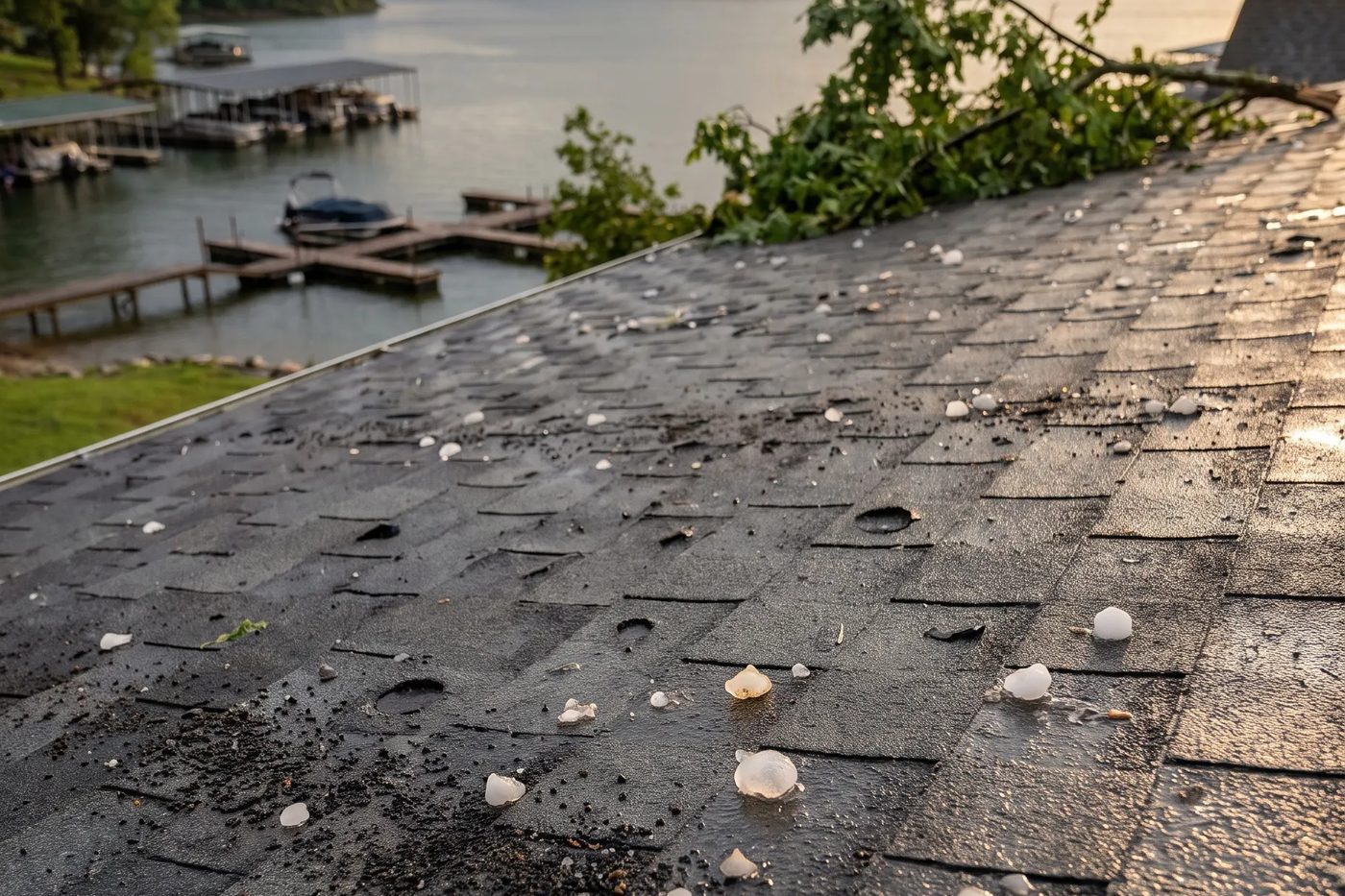
What inch-and-a-half hail actually does to a roof
An asphalt shingle is not one solid material. It is a fiberglass or felt mat, saturated in asphalt, with a layer of ceramic granules pressed into the surface. Those granules are the sunscreen. They take the ultraviolet beating so the asphalt underneath stays flexible and waterproof. Strip them off and the mat begins aging at a rate the shingle was never designed for.
When a stone around an inch and a quarter hits at storm speed, three things happen at once:
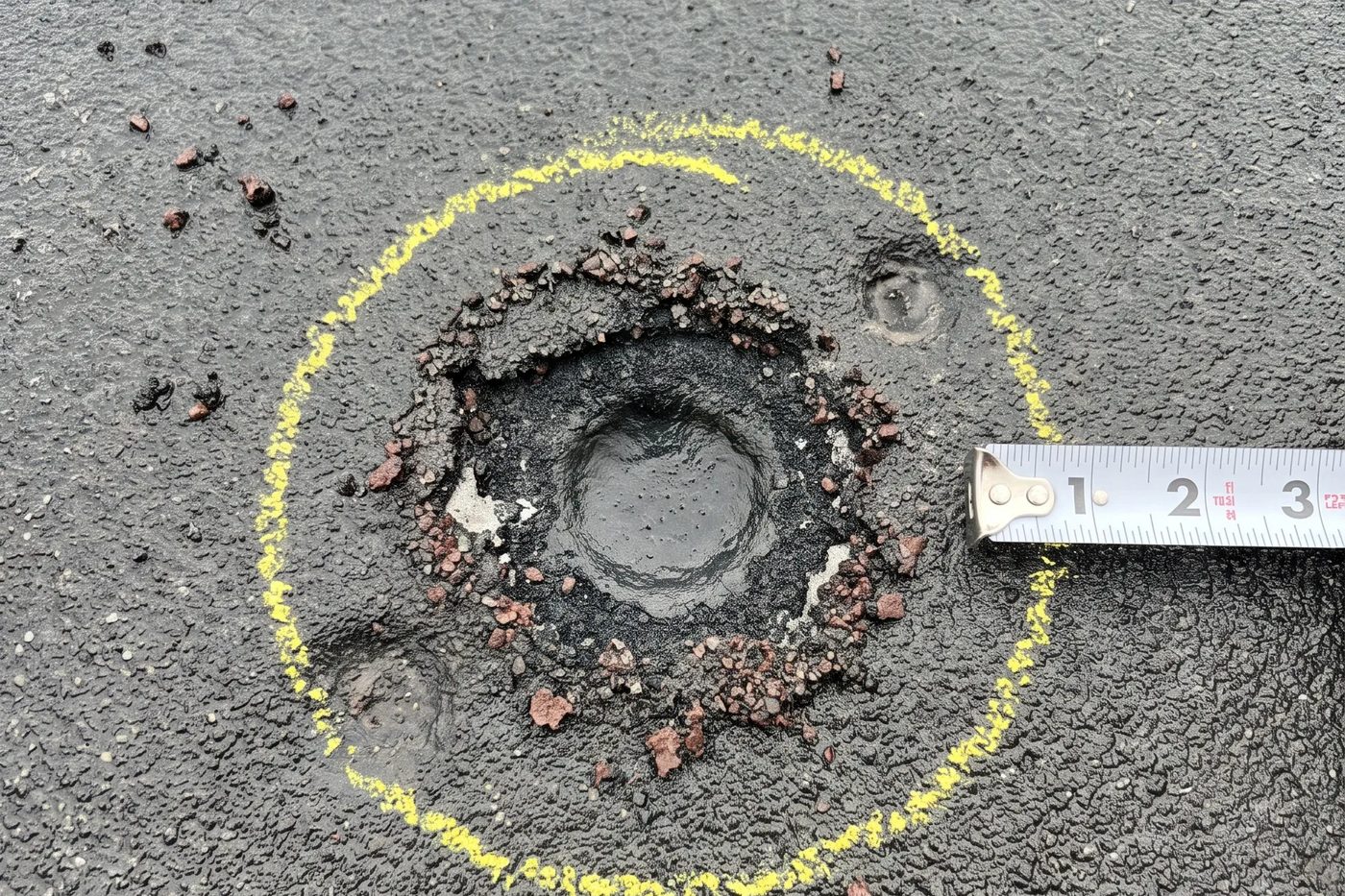
- Granule loss. A circle of granules is knocked free, exposing the black asphalt mat underneath. That spot now weathers years faster than the shingle around it.
- Mat bruising. The impact crushes and fractures the mat itself, the way a bruise works under skin. The shingle still lies flat and still looks fine from the yard. It has a soft, compromised spot that will crack open as it goes through freeze and thaw this winter.
- Damage to everything softer than the roof. Gutters, downspouts, vent caps, ridge vents, flashing, siding and window wraps dent long before shingles show obvious harm. Those dents are often the clearest evidence that hail of a damaging size actually fell on your specific address.
This is why the timeline fools people. The roof does not leak on September 17. It leaks the following spring, or the winter after that, and by then it reads like an old roof that finally gave out rather than storm damage from a dated, documented, warned-on storm.
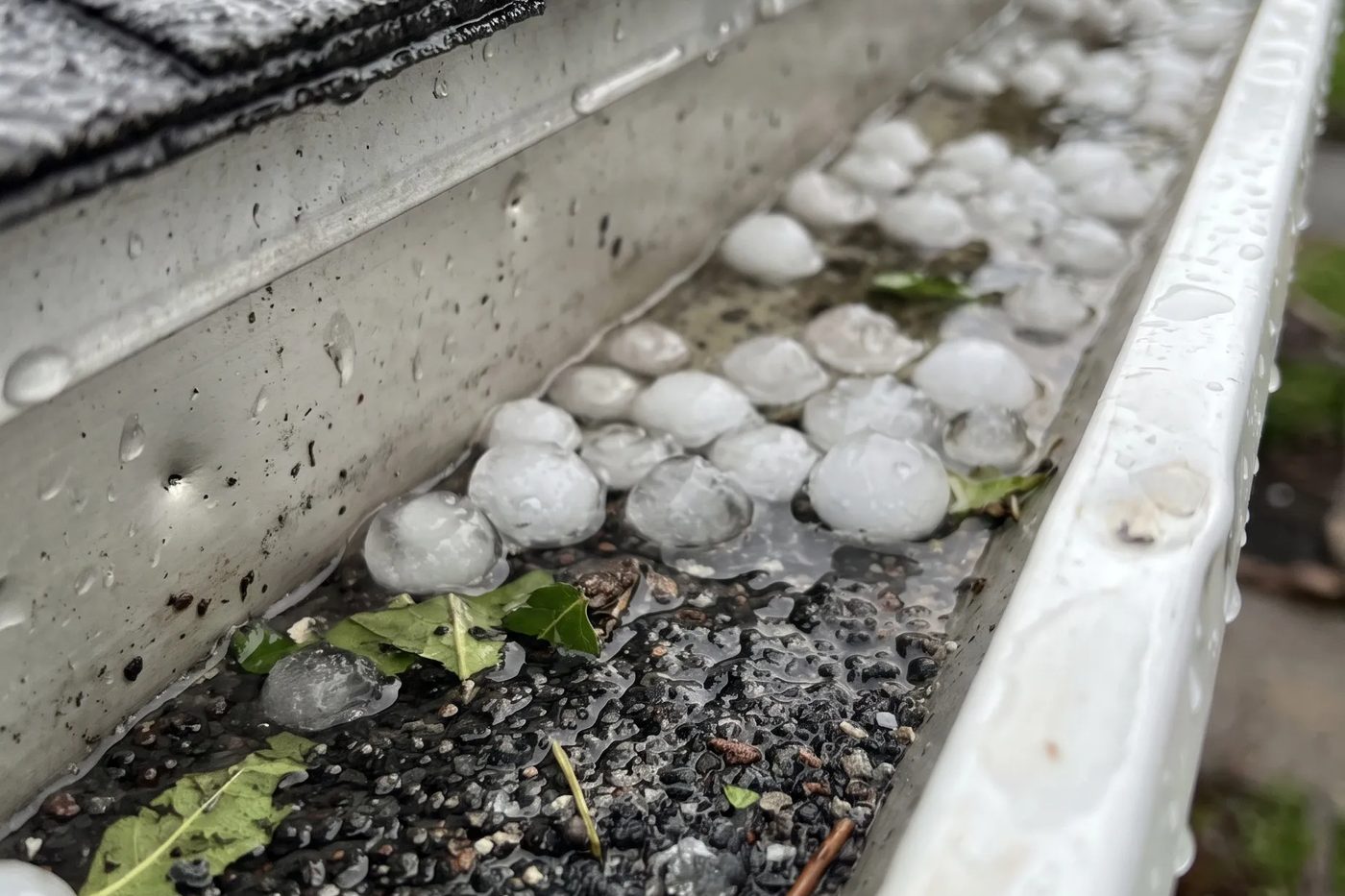
Signs you can check from the ground, safely
Before anyone climbs anything: please stay off the roof. A hail-struck roof can have loose granules acting like ball bearings underfoot, and around the lake plenty of homes have steep pitches over a walkout drop. Everything on this list can be checked with both feet on the ground.
- Granules in the gutters and at the splash blocks. A dark, gritty sediment line, or a pile of black sand where the downspout empties.
- Dents in gutter faces and downspouts. Look along the run at a low angle with the sun behind you — dimples show up in the reflection.
- Dings on soft metals. Vent caps, turbine vents, flashing, gutter aprons and the metal on top of chimneys bruise first.
- Spatter marks. Clean circles on a dusty deck rail, a grill lid, an air conditioner's fins or a windowsill, where hail struck and washed the surface.
- Shredded or stripped landscaping on the same side of the house as the hail's approach, a good indicator of which roof slopes took the worst of it.
- Shingle grit in the driveway or on the walkway after the rain dries.
- Lifted, creased or missing shingles visible against the skyline, which point to the wind side of this storm rather than the hail.
The wind damage matters as much as the hail
The National Weather Service attributed most of the reported damage on September 16 to thunderstorm wind, not hail, and wind damages a roof in a completely different way. Instead of bruising the surface, wind gets under the leading edge of a shingle and breaks the factory seal strip that bonds each course to the one below it.
A shingle whose seal has broken can drop back down and look perfectly normal. It is no longer sealed, which means the next storm can lift it freely, drive rain sideways underneath it, and wet the decking with nothing visible happening on top. Creased shingles — a hard fold line across the tab where it bent back and flopped down — are the fingerprint of that, and they are a legitimate finding on a claim.
What to do in the first 72 hours
- Deal with anything actively leaking first. Move what is under it, get a container down, and call for emergency service. We answer the phone around the clock at 1-800-564-6232 and run 24/7 emergency roof repair for exactly this window.
- Photograph everything now, with dates. Debris in the yard, dents in the gutters, spatter on the deck, water stains on ceilings. Photographs taken this week are worth far more to a claim than photographs taken in March.
- Write down what you experienced. Roughly what time the hail fell, how long it lasted, how big the stones looked next to a coin. That firsthand account supports the official storm reports for your address.
- Get a documented inspection before you call your carrier. Knowing whether you actually have damage, and how much, puts you in a far better position than opening a claim blind. Our storm and hail damage inspection is free and comes with photographs you keep either way.
- Do not let anyone start work on a handshake and a clipboard. Storms bring crews from three states away into the lake area within days.
Insurance, deductibles, and Missouri law
A hail or wind claim is usually handled as a covered peril, with your deductible applying. The part worth knowing before someone knocks on your door: in both Missouri and Illinois, it is illegal for a contractor to waive, absorb, rebate or otherwise pay your insurance deductible for you. We wrote about why deductible waiving is against the law because homeowners get offered it constantly after a storm like this one, and it puts the homeowner, not just the contractor, in a bad spot.
If you would rather understand the process before you start it, our insurance claim help page walks through how an adjuster visit actually goes and what we do to make sure real damage does not get missed.
Why a local Lake of the Ozarks roofing contractor matters right now
Within a week of a hail event, the lake area will fill with door-knockers. Some are fine. Many are storm-chasing crews who will be in another state by the time their work needs standing behind, and a roof warranty is only worth the company still being around to honor it.
John Beal Roofing has been family-run since 1947 and is now in its third generation, with more than 50,000 satisfied customers, a BBB Torch Award for ethics, and a lifetime workmanship warranty on every installation. We keep a local Lake of the Ozarks office, which is why we can be on a roof in Osage Beach or Linn Creek quickly instead of dispatching from three hours away. We handle everything from a targeted roof repair to a full roof replacement, and we will tell you honestly when a roof does not need replacing.
Storm inspections around the lake are free, including Osage Beach, Camdenton, Lake Ozark, Sunrise Beach, Laurie, Four Seasons and the surrounding communities. Call 1-800-564-6232 — answered 24 hours a day, by a person.
Frequently asked questions
Was the September 16, 2026 hail big enough to damage a roof at the Lake of the Ozarks?
Yes. Trained spotters near Linn Creek reported stones around 1.25 inches, with reports around the lake running from pea size up to roughly an inch and a half. Damage to asphalt shingles generally begins around the one-inch mark, and stones at 1.25 to 1.5 inches routinely bruise the shingle mat and strip protective granules even when the roof still looks normal from the ground.
How soon do I need to have my roof looked at after this storm?
Sooner is better for two reasons. Bruised shingles let water in slowly, so the leak usually shows up months after the storm that caused it. And insurance policies expect damage to be reported promptly after the event that caused it: the longer the gap, the harder it is to tie the damage to the September 16 storm rather than to age or wear.
Can I tell if I have hail damage without getting on the roof?
You can find strong clues from the ground: granules collecting in gutters and at downspout splash blocks, dents in gutter faces, dings on soft metals like vents, flashing and gutter aprons, and spatter marks on decks and window sills. Please do not climb up to confirm it. Wet or hail-struck roofs are genuinely dangerous, and a bruise is easy to walk right past if you do not inspect roofs for a living.
Does a hail inspection cost anything, and does filing a claim raise my rate?
Our inspection and damage documentation are free. Whether to file is your decision to make with your carrier; we simply show you what is up there in photographs. In Missouri and Illinois, be aware that a contractor offering to waive, absorb or pay your insurance deductible is breaking the law, and an offer like that is a reliable sign of a company you do not want on your roof.
Why use a local Lake of the Ozarks roofing contractor instead of a company that showed up after the storm?
Out-of-town crews follow hail, and they are gone before the first warranty call. John Beal Roofing has been family-run since 1947, now in its third generation, with a local Lake of the Ozarks office, a lifetime workmanship warranty, and a phone answered 24 hours a day. When your roof needs attention in February, we are still here.