
A severe thunderstorm moved through O’Fallon and northwestern St. Charles County on the afternoon of Thursday, September 17, 2026, and the National Weather Service put a Severe Thunderstorm Warning on it immediately — severity severe, urgency immediate, event classified as observed rather than radar-indicated. The hazards named in that warning were 60 mph wind gusts and quarter-size hail, and the impact statement was blunt: hail damage to vehicles expected, wind damage to roofs, siding and trees.
If you live in 63366 or anywhere along that path, the roof over you took one-inch ice at highway speed while the wind was trying to peel it. Here is exactly what was reported, what stones that size do to asphalt shingles, and what is worth doing in the next few days.
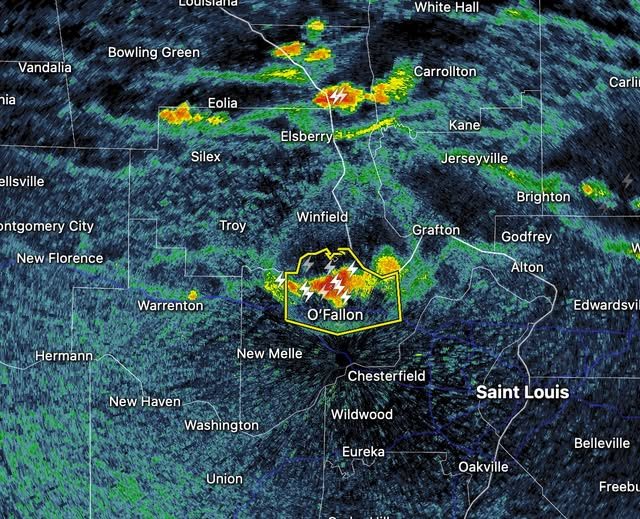
What the National Weather Service reported on September 17
The warning was issued at 3:38 PM local time and ran until 4:30 PM CDT — the heart of the afternoon commute. At issuance the storm was located over St. Paul, and the detail that matters most to your roof is what the NWS said next: the storm was stationary. A cell that sits still holds its hail core over the same rooftops instead of sweeping past them, so the same shingle takes strike after strike rather than one glancing hit. That is the difference between a roof with a few scars and a roof with a claim.
The warning text placed the storm near St. Paul, O’Fallon, St. Peters, Josephville, Lake St. Louis, Wentzville, Dardenne Prairie, Cottleville and St. Charles around 3:40 PM CDT, and specifically called out Interstate 70 between exits 210 and 227. If your commute runs that stretch of I-70, your vehicle and your house were likely under the same cell within the same hour.
What quarter-size hail and 60 mph wind actually do to a roof
Quarter-size means roughly one inch in diameter, and one inch is the number to remember: it is broadly the point where asphalt shingles start sustaining genuine damage rather than cosmetic marks. The damage arrives in three forms, and only one of them is visible from your yard.
- Granule loss. The colored granules on a shingle are its sunscreen. Hail drives them off in patches, and the asphalt mat underneath begins aging in UV immediately. This is the damage that shortens a roof’s life by years without ever producing a drip.
- Mat bruising. A strike can fracture the fiberglass mat beneath an intact-looking surface. It feels like a soft spot underfoot, similar to pressing a bruise on fruit, and it is a future leak on a delay.
- Broken seal from wind. Sixty mph gusts lift shingles, break the adhesive strip holding each course down, and lay them back looking untouched. The shingle is still there and no longer sealed — the next ordinary thunderstorm is what takes it off.
The same storm hit vinyl siding on the north and west elevations, where one-inch stones commonly dent or split panels outright, and it filled yards across St. Charles County with limbs from those straight-line winds.
What you can safely check from the ground in 63366
Stay off the roof — a wet or hail-scoured roof is genuinely dangerous, and the evidence you need is visible from the ground anyway.
- Look in the gutters and at the downspout outlets. A pile of granules that looks like coarse black sand is the clearest ground-level sign your shingles were hit.
- Check soft metal first. Gutter aprons, downspouts, roof vents, furnace and plumbing flashing, and your air conditioner’s condenser fins dent before shingles show anything. Dents there mean the roof took the same stones.
- Walk the north and west walls. Those elevations faced this cell. Look for cracked or dimpled siding, torn window screens, and dented garage doors.
- Look for shingle debris and grit on the driveway and deck. Fresh granules and shingle fragments on hard surfaces mean material came off the roof.
- Check the ceilings inside. Fresh staining anywhere, especially near chimneys, skylights and bathroom vents, means water already found a path.
Transcript: “Quarter-size hail and 60 mile an hour wind hit O’Fallon Thursday. You will not see that damage from the ground. My crew will check your roof for free. Call me at 1-800-John Beal.” — John Beal, owner, John Beal Roofing
What to do in the first 72 hours
The first three days set up everything that follows, and none of it requires a ladder.
- Photograph everything now, with the date attached. Roof, gutters, siding, screens, vehicles, yard debris, and the piles of granules — multiple angles, wide and close. The storm date is the thing carriers argue about, and time-stamped photos end that argument.
- Write down what you experienced. The time the hail started, how long it lasted, the size you saw, and whether the wind came first. A homeowner’s own account carries weight in an adjuster’s file.
- Get a free written inspection before you call the carrier. Knowing whether you have real, documentable damage is what separates a supported claim from a claim that gets denied and still lands on your record.
- Do not sign anything a door-knocker hands you on the porch. Storm-chasing crews were canvassing O’Fallon within a day. A contingency agreement signed in a driveway can tie your claim to a company that will not be in Missouri next spring.
- Save receipts for anything urgent. Emergency tarping and water mitigation are usually reimbursable, but only with documentation.
Insurance, deductibles, and what Missouri law actually says
Most homeowners policies in St. Charles County cover sudden storm damage from wind and hail. What they do not cover is ordinary wear, so the entire question in a hail claim is whether the damage is storm-caused and recent — which is why documentation beats argument every time.
Two terms decide what actually lands in your account. Under ACV (actual cash value), the carrier pays replacement cost minus depreciation, and you cover the depreciation plus your deductible. Under RCV (replacement cost value), you get an initial ACV payment, and the held-back depreciation is released once the work is completed and invoiced — leaving your deductible as the only real out-of-pocket cost. Read which one your policy uses before you file.
And one thing worth stating plainly: in Missouri and Illinois it is illegal for a contractor to waive, absorb or rebate your insurance deductible. Anyone who offers to “eat the deductible” is proposing to break the law with your claim as the vehicle.
Why a local St. Charles County roofing contractor matters right now
Every hail event in the St. Louis metro brings a wave of out-of-state crews with magnetic door signs and a hotel room rented by the week. They are quick, they are cheap, and they are gone before the first warranty call — leaving the homeowner holding a roof nobody will stand behind.
John Beal Roofing has been family-run since 1947 and is now multi-generational. We work across St. Charles County every week, we run our own crews instead of subcontracting the work out, we carry a limited lifetime workmanship warranty, and someone answers the phone 24 hours a day — because storms do not wait for business hours. If your roof in O’Fallon, Wentzville, St. Peters, Dardenne Prairie, Cottleville or Lake St. Louis was under that cell on September 17, the inspection is free and it is written.
Frequently asked questions
Was the September 17, 2026 hail in O’Fallon big enough to damage a roof?
Quarter-size hail measures about one inch across, and one inch is the threshold where asphalt shingles begin to take real damage. Paired with the 60 mph gusts the National Weather Service reported in that same warning, stones that size routinely bruise the shingle mat, knock granules loose and break the factory seal that holds each shingle course down. A roof can pass a glance from the driveway and still have taken a hit.
I did not see any damage from the ground. Do I still need an inspection?
Almost nobody sees hail damage from the ground, which is exactly why it goes unclaimed until it leaks. Bruising shows up as soft, dark spots where granules were driven off the mat, and those spots are invisible at a distance and often invisible from a ladder. A free written inspection puts someone on the roof with a chalk square and a documented count while the storm date is still fresh.
How long do I have to file a claim for the September 17 storm?
Most Missouri policies give you a window measured in months, not years, and some now carry a shortened window specifically for wind and hail. The bigger practical problem is proof: the longer you wait, the easier it becomes for a carrier to argue the damage came from a different storm or from ordinary wear. Getting documented in the first few weeks protects the claim far more than the deadline does.
Is it legal for a roofer to waive or cover my deductible?
No. In both Missouri and Illinois it is against the law for a contractor to pay, absorb, rebate or waive your insurance deductible, and an offer to do it is a reliable sign of a company you do not want on your roof. Your deductible is your share of the claim, and a legitimate contractor will tell you that plainly.
Why use a local contractor instead of the crews that showed up after the storm?
Out-of-town crews follow hail across the map and are gone before the first warranty call. John Beal Roofing has been family-run since 1947 and is now multi-generational, we run our own crews rather than subcontracting the work out, we carry a limited lifetime workmanship warranty, and our phone is answered 24 hours a day. When something needs attention next February, we are still here.