
“How long is this going to take?” is one of the first things homeowners ask once they decide on a new roof. It is a fair question. For a day or two your house will be loud, there will be a dumpster in the driveway, and a crew will be working over your head. The video at the top of this page shows a full roof replacement compressed into about twenty-five seconds, so you can see every stage before it happens at your house.
Below we break down what you are watching, how long each part really takes, what stretches a job out, and how to read a contractor’s timeline. For the quick version, John answers the same question in our roof replacement Q&A. For the full eleven-step process from inspection to warranty, see roof replacement, step by step.
The short answer
For most single-family homes with asphalt shingles, the work on the roof takes one to two days. A smaller, simple, walkable roof is often finished in a single day. A large, steep or cut-up roof with dormers, valleys and a chimney is more likely to take two days or more. The entire project, counting the inspection, estimate, color choice, permit and scheduling, usually runs a few weeks from first call to final walk-through.
Watch a roof replacement, stage by stage
The time-lapse follows one house from a worn roof in the morning to a finished roof at sunset. It is an illustration, filmed from a fixed spot across the street, so you can watch the order of operations. Here is what happens in each stage, and what you will notice from the ground.
- Tear-off. The old shingles, underlayment and worn flashing come off down to the wood deck and go straight into the dumpster. This is the loudest, messiest part of the job. If there are two or three layers of old shingles, every layer comes off, which adds time.
- Decking check and repair. With the deck exposed, the crew looks for soft, rotted or delaminated boards, usually near valleys, eaves, chimneys and old leaks. Bad sheets are cut out and replaced. Nobody can know exactly how much decking needs work until this moment, and it is the most common reason a job runs longer than planned.
- Underlayment and flashing. Ice and water shield goes into valleys, along the eaves and around penetrations. Synthetic underlayment covers the rest of the deck, and drip edge goes on along the edges. New flashing goes in at walls, chimneys and pipes. Once this layer is down, the house is protected from weather even before shingles go on.
- New shingles. Starter strips go along the eaves and rakes, then shingles are nailed course by course up to the ridge and finished with matching ridge cap. On the time-lapse this is the stage where the roof visibly changes color.
- Cleanup and walk-through. The crew clears debris from gutters and beds, runs magnetic sweepers across the lawn and driveway to pick up nails, and the dumpster is hauled away. A final walk-through confirms the work before you sign off.
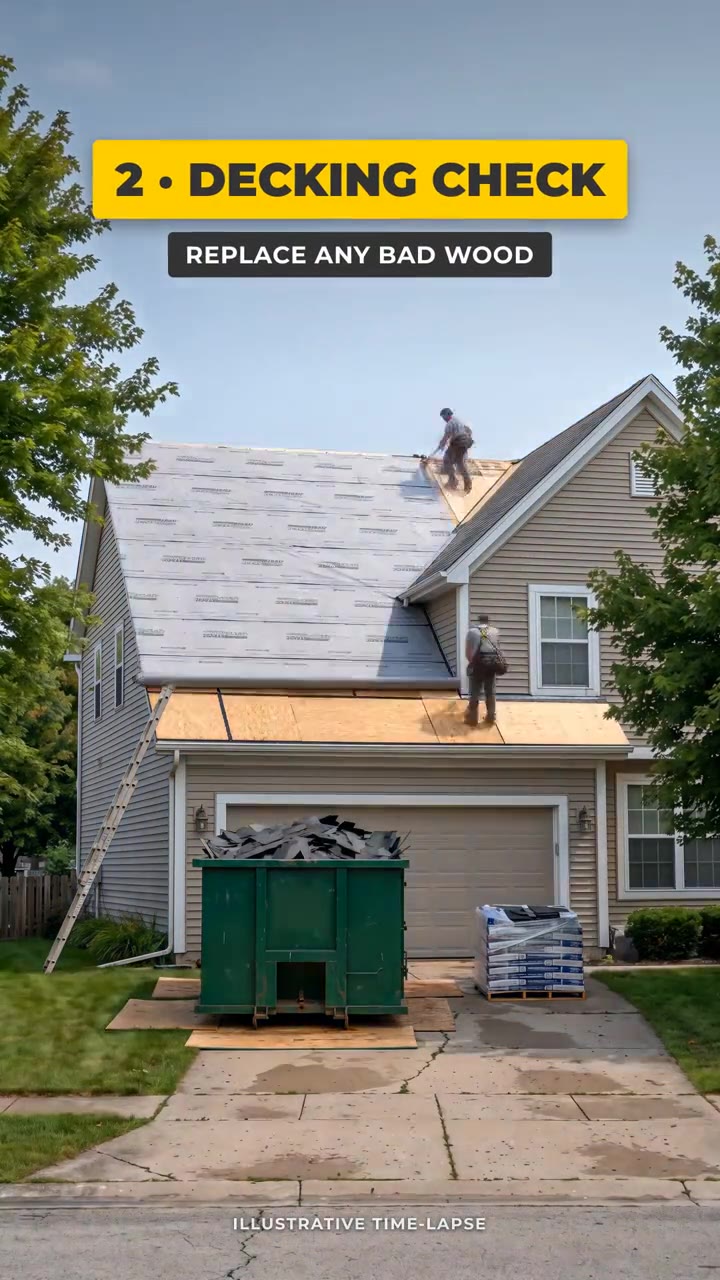
Video transcript: How long does it take to replace a roof? Here's a full replacement, sped up. Tear-off. Check and replace any bad decking. Underlayment and flashing. New shingles, then cleanup and a walk-through. Your timeline depends on roof size and pitch, what's under the old shingles, and the weather. Call John Beal Roofing for a free inspection. 1-800-JOHN-BEAL.
What makes a roof replacement take longer
- Size and pitch. More squares of roof means more hours. Steep roofs need harnesses, roof jacks and slower, more careful movement on every section, so two houses with the same footprint can take very different amounts of time.
- Layers of old roofing. One layer tears off faster than two or three, and the extra weight has to be hauled away.
- Decking damage. Soft or rotted wood from an old leak has to be replaced before anything new goes down. If your roofline already dips, read what a sagging roof means before you schedule, because structural repairs come first.
- Complexity. Dormers, valleys, skylights, chimneys and walls that meet the roof all need flashing done by hand.
- Material. Asphalt shingles are the fastest system to install. Specialty roofs such as ProVia metal shake or Brava composite tile involve different components and details, so ask for a timeline specific to that material.
- Weather. Rain, high wind, extreme heat and ice all change the schedule (more on that below).
The full timeline, from first call to finished roof
The roof itself is only one or two days of a longer process. A typical sequence looks like this:
- Free inspection, with photos of each slope and a look in the attic.
- Written estimate naming the shingle line, underlayment, flashing, ventilation and how replacement decking is handled.
- Material and color selection. Our shingle color selector helps you choose before samples arrive.
- Permit and scheduling. Permit rules vary by city. Spring and the weeks after a big hailstorm are the busiest times to schedule.
- Delivery, usually the day before or the morning of the install.
- Install day or days, the part shown in the time-lapse.
- Final walk-through, plus a city inspection where required, and your warranty paperwork.
How Midwest weather changes the schedule
Roofs do not go on in the rain. In Missouri, Kansas, Illinois, Indiana and Kentucky, a clear morning can turn into an afternoon thunderstorm, so good crews watch the radar and plan the tear-off around it. They only open as much roof as they can dry in the same day. If weather moves in, they stop, cover the open areas and pick back up when the deck is dry. In winter the job waits for dry days with no ice or frost on the deck. A weather delay is frustrating, but installing shingles on a wet deck is worse.
How to get ready for install day
- Move cars out of the garage and driveway the night before.
- Take pictures, mirrors and shelves off walls that share framing with the roof, because the hammering vibrates them.
- Keep pets and kids inside and away from the work area.
- Move patio furniture, grills and planters away from the house.
- Make sure the crew can reach an outdoor outlet.
Ask for a timeline in writing
A contractor who has done this thousands of times should be able to tell you when they can start, roughly how long your roof will take, what happens if they find bad decking, how the house is protected if weather stops the job, and when cleanup and the walk-through happen. If you get vague answers to those five questions, keep looking.
Replacing your roof with John Beal Roofing
John Beal Roofing has been family-owned for three generations and has served more than 50,000 customers across the Midwest. We measure and inspect your roof before we quote, so the timeline we give you is built on your house, not a guess. Every roof we install is backed by a lifetime workmanship warranty plus the manufacturer’s product warranty, and our phone is answered 24/7 if you have a question while the work is under way. Call 1-800-564-6232 or book a free inspection, and see our roof replacement page for more.
Frequently asked questions
How long does it take to replace a roof?
Most single-family homes take one to two days on the roof for an asphalt shingle replacement. The full process from inspection to final walk-through usually takes a few weeks.
Can a roof be replaced in one day?
Many smaller, simple, walkable roofs are finished in a single day. Larger, steeper or more complex roofs, multiple layers of old shingles, or bad decking can push the job into a second day or longer.
What makes a roof replacement take longer?
Roof size and pitch, extra layers of old shingles, rotted or soft decking that has to be replaced, lots of flashing around chimneys, skylights and walls, specialty materials, and rain or high wind.
What happens if it rains during a roof replacement?
Work stops. The crew covers any open areas of the roof so the house stays dry, and picks back up when the roof deck is dry. Shingles should never be installed over a wet deck.
Do I need to be home during a roof replacement?
Not necessarily, but someone should be reachable. Move cars out of the garage, keep pets inside, and take fragile items off walls that share framing with the roof.
How long does the whole process take from first call to finished roof?
Usually a few weeks. The inspection and written estimate come first, then material and color selection, the permit, scheduling, the install itself, and the final walk-through. Busy storm seasons can stretch the scheduling step.